In this article (11 sections)
- What does the 16-week plan look like?
- Weeks 1 to 3: Python, Pandas, Git and SQL
- Weeks 4 to 7: the maths and statistics you will actually use
- Weeks 8 to 10: machine learning, done properly
- Weeks 11 to 13: deep learning and LLMs
- Weeks 14 to 16: deployment and a capstone
- Where does a free plan stop working?
- Our Data Science programme, and who it is not for
- Who this is not for
- What to do this week
- Sources
Related programme: the Data Science course (6 months; ₹1,30,000 (inclusive of GST) · EMI from ₹5,000/month).
In short: you can learn most of data science free. A realistic plan is 16 weeks at 10 to 12 hours a week: Python and Pandas on Kaggle Learn, SQL on Kaggle, maths through 3Blue1Brown, statistics from the free OpenIntro book, machine learning with Kaggle and the free ISLP book, deep learning with fast.ai, LLMs with the Hugging Face course, and a final project on Indian open data. I checked every resource below on 9 November 2026. What free cannot give you is feedback on your work and practice for the interview.
I am Pankit Kumar. I lead the Data Science programme at NeuraPath and work as a Senior Data Scientist at Parexel. People often ask me for "one free data science course". There isn't one that does the whole job, but there is a good free resource for every part of it. This is the order I would take them in, with a build for every block so that you finish with projects you can show, as well as certificates.
Not sure where you would start? Book a 15-minute counselling call and we will tell you which weeks you can skip.
What does the 16-week plan look like?
Five blocks, in the order the skills build on each other. Each block ends with something you make.
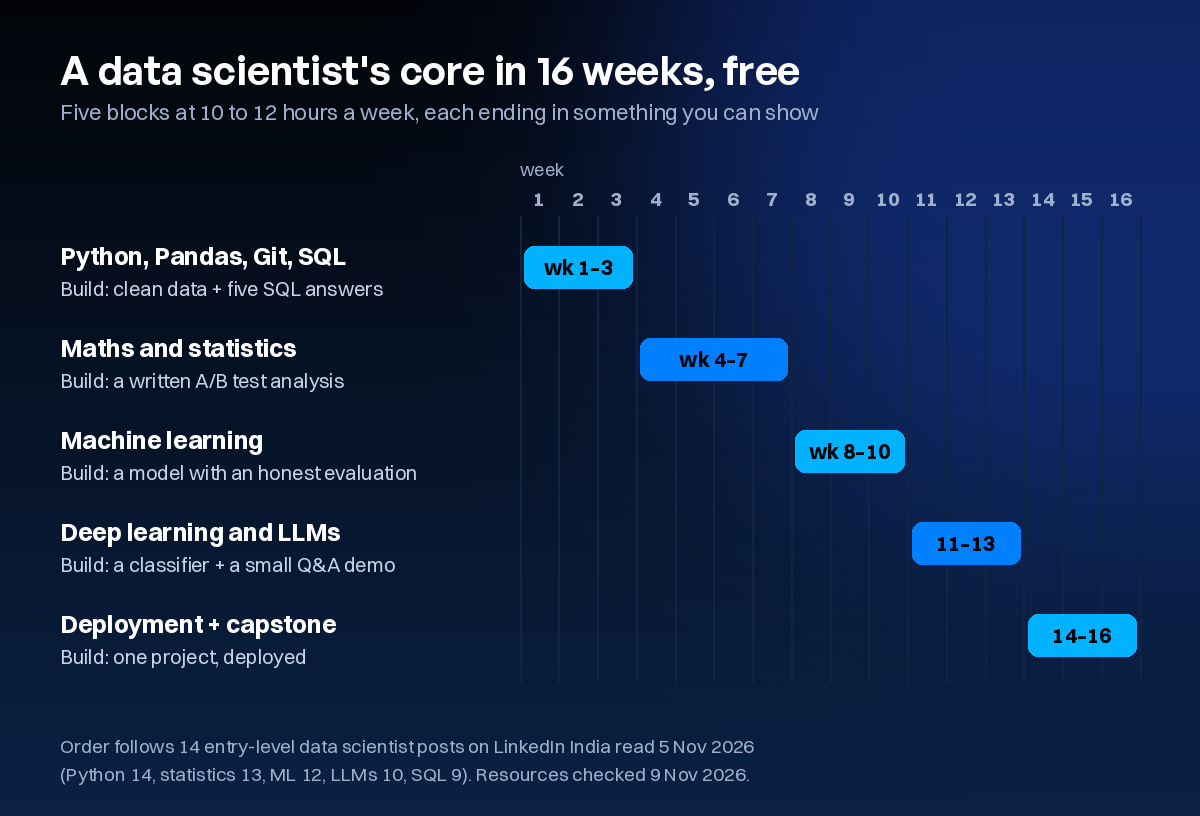
| Weeks | Block | Free resources | You build |
|---|---|---|---|
| 1–3 | Python, Pandas, Git, SQL | Kaggle Learn Python, Pandas, Intro to SQL and Advanced SQL; GitHub Skills | A cleaned dataset and five SQL answers in a GitHub repo |
| 4–7 | Maths and statistics | 3Blue1Brown linear algebra and calculus; OpenIntro Statistics; Udacity A/B Testing | A written analysis of one A/B test |
| 8–10 | Machine learning | Kaggle Intro and Intermediate ML; ISLP book and labs; scikit-learn guide | A model with a proper test set and an error analysis |
| 11–13 | Deep learning and LLMs | fast.ai; PyTorch Learn the Basics; Hugging Face LLM Course | An image or text classifier, and a small question-answering demo |
| 14–16 | Deployment and capstone | ML Zoomcamp (self-paced); MLflow quickstart; data.gov.in | One end-to-end project, deployed, with a README |
Ten to twelve hours a week is the honest number. Less than that and the plan stretches to six months, which is fine, as long as you keep the order.
Weeks 1 to 3: Python, Pandas, Git and SQL
Start on Kaggle Learn. Its Python course lists "5 (estimated)" hours to the certificate and its Pandas course "4", and the page says they come at "No cost, like all Kaggle Learn Courses". You write code in the browser, so nothing to install in week 1. If you have never programmed, add the first weeks of Harvard's CS50P, which is free through CS50's own site and covers "ten weeks of material". You do not need all ten weeks for this plan.
In week 2, take GitHub's "Introduction to GitHub", which says you can get started "in less than an hour", and put every exercise from now on in a public repository. Hiring managers look at it.
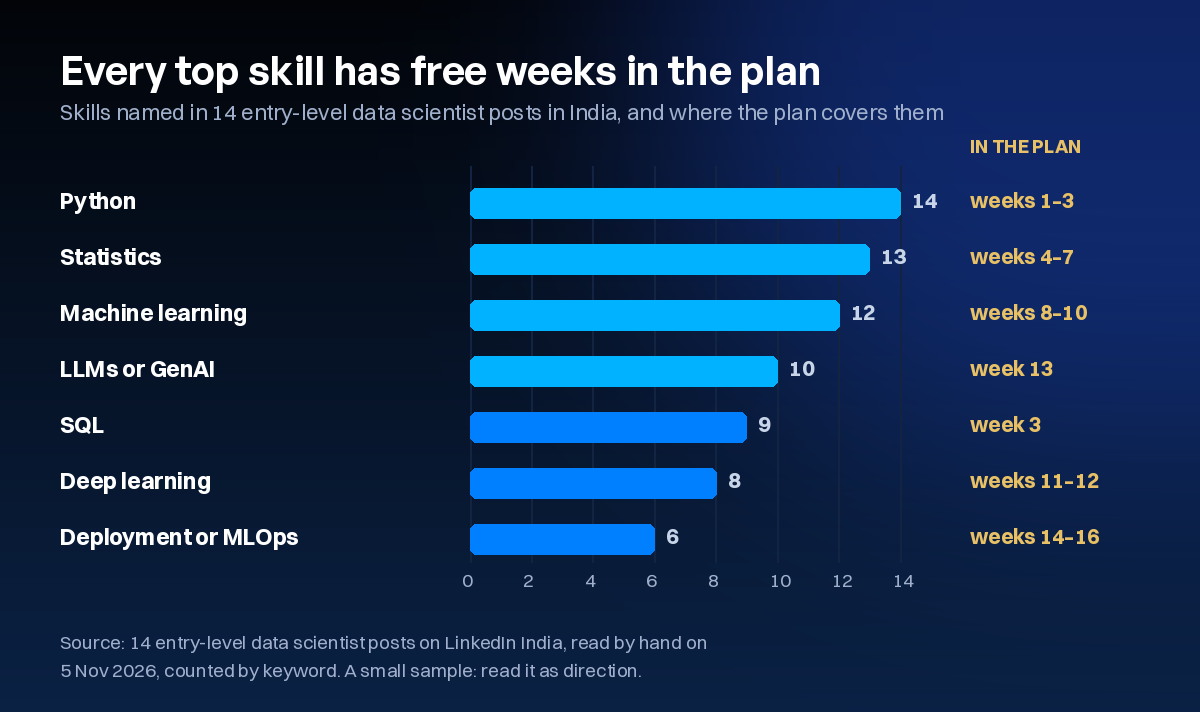
Week 3 is SQL. Kaggle's Intro to SQL lists about 3 hours and Advanced SQL about 4, run on Google BigQuery inside Kaggle. Get as far as joins, window functions and CTEs. In data scientist posts I read on 5 November 2026, SQL appeared in 9 of 14 entry-level posts, so it is not optional.
Build: take one messy public dataset, clean it in Pandas, load it, and answer five questions in SQL. Commit both.
Weeks 4 to 7: the maths and statistics you will actually use
You do not need a maths degree. You need to be comfortable with vectors, matrices, derivatives and probability, and you need statistics properly.
- Linear algebra and calculus: 3Blue1Brown's "Essence of linear algebra" (16 videos) and "Essence of calculus" (12 videos) are both described as "a free course", and together run to about six hours of video by my count. Watch them for intuition. Keep the free *Mathematics for Machine Learning* book (Deisenroth, Faisal and Ong) as a reference; its authors say "We will keep PDFs of this book freely available."
- Statistics: OpenIntro Statistics, 4th edition, is a free PDF. Its download page asks for an optional contribution, and you can set it to zero. Work through descriptive statistics, probability, distributions, inference and regression, and do the exercises. Khan Academy's Statistics and probability course (16 units) is good for anything that does not click.
- A/B testing: Udacity's "A/B Testing" course, taught by Google engineers, is still listed as a free course with five lessons. Product companies ask about experiments in interviews, and almost every free plan skips this.
Statistics was named in 13 of the 14 entry-level data scientist posts I read on 5 November, second only to Python. This is the block people rush, and it is the one interviews expose.
Build: find a public A/B test dataset and write a one-page analysis: the hypothesis, the test, the confidence interval and your recommendation.
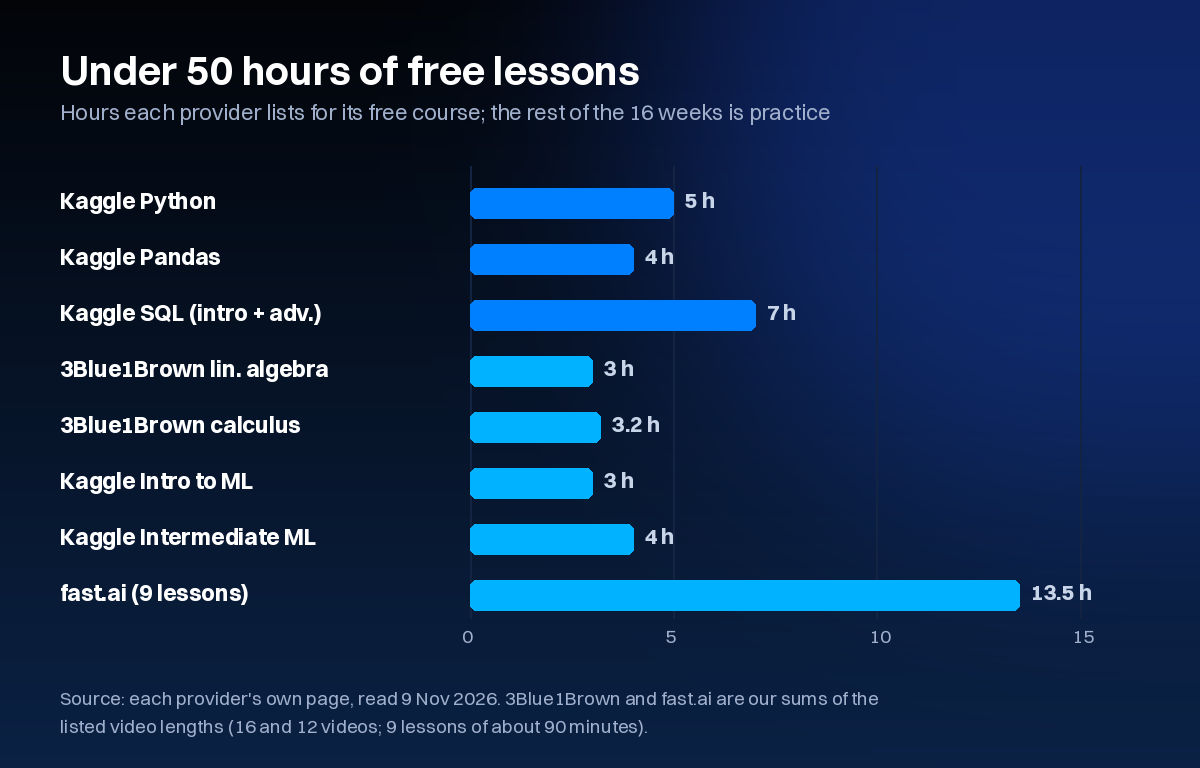
Look at those hours. The listed course time for the core of this plan adds up to under 50 hours. The rest of the 16 weeks is practice: exercises, projects and getting stuck. That is where the learning happens, and it is the part no course page counts.
Want to see how a full programme sequences this? Our Data Science curriculum lists every module with its live hours and the project at the end of each.
View the curriculumWeeks 8 to 10: machine learning, done properly
Use three resources together. Kaggle's Intro to Machine Learning (about 3 hours) and Intermediate Machine Learning (about 4 hours) get you training models quickly. The ISLP book, *An Introduction to Statistical Learning with Applications in Python*, is free to download from its own site, and its Python edition was published in 2023. It explains why each method works, and each chapter has a Python lab. Read the chapters on linear and logistic regression, resampling, tree-based methods and unsupervised learning. When you need the details of a function, the scikit-learn user guide is the reference.
One note, because I am asked about it often. Andrew Ng's Machine Learning Specialization on Coursera is excellent, but on 9 November 2026 its FAQ said "No, you cannot take this course for free" and that "A Coursera subscription costs $49 / month". Financial aid is available. The free resources above cover the same ground.
Spend most of these three weeks on evaluation, not on trying more models. Hold out a test set before you start. Choose the metric that matches the cost of a mistake. Look at the rows the model gets wrong. Kaggle's Titanic competition "runs indefinitely with a rolling leaderboard", so it is a fine first project, but do one more on a dataset nobody has solved a thousand times.
Build: one classification project with a held-out test set, a confusion matrix and a paragraph on where the model fails and why.
Weeks 11 to 13: deep learning and LLMs
fast.ai's "Practical Deep Learning for Coders" is the best free deep learning course I know for people who learn by doing. The site says "There are 9 lessons, and each lesson is around 90 minutes long", and it is free. Pair it with PyTorch's official "Learn the Basics" tutorial, because most teams now work in PyTorch.
Then spend week 13 on the Hugging Face LLM Course. Hugging Face says it is "completely free and without ads" and that each chapter takes about a week at "approximately 6-8 hours of work per week". Do the first chapters: transformers, tokenisers, and using and fine-tuning a pre-trained model. There is no certificate for it, and that does not matter.
Ten of the 14 entry-level data scientist posts I read on 5 November mentioned LLMs or generative AI. Freshers are now expected to know what a transformer does and how to use one sensibly. You do not need to train one.
Build: a small text classifier with a pre-trained model, and a demo that answers questions from ten of your own documents, with a check of whether each answer matches its source.
Weeks 14 to 16: deployment and a capstone
A model that only runs in your notebook is half a project. DataTalksClub's Machine Learning Zoomcamp is free ("Learn ML engineering for free in 4 months!") and its deployment modules teach serving a model as a web service and packaging it with Docker. One caveat: the 2026 live cohort started on 14 September 2026, so if you start now you will be working through the recorded material on your own, and its certificate is only given through a live cohort. Add MLflow's free quickstart so you can track your experiments.
Then the capstone. Pick an Indian dataset from the Open Government Data Platform India, which listed 358,249 resources when I checked on 9 November 2026. Ask a question that matters to someone, build the model, deploy it, and write a README that a hiring manager can read in three minutes.
Build: one end-to-end project, deployed, with the README and an honest section on its limits.
Where does a free plan stop working?
Free resources are good at teaching. They are weak at four things:
- 1Feedback. Nobody reviews your code or tells you that your evaluation is leaking test data. It is the most common problem I see in self-taught projects, and the person usually did not know.
- 2Structure and deadlines. Many people who start a free plan stall around the statistics block. A cohort and a weekly deadline fix that more reliably than willpower.
- 3Interview practice. Explaining your model to someone who keeps asking "why?" is a skill. You need reps with a person.
- 4Getting seen. Referrals, mock interviews and introductions to hiring teams are not on any course page.
If you can get these elsewhere, from a study group, a mentor at work or an active community, the free plan can take you a long way. Many people do exactly that, and freshers are hired into associate and junior data scientist roles every year. If you cannot, that gap is what a paid programme is for.
Is a ₹1,30,000 data science course worth it for you?
Answer five questions. You see the result straight away; nothing is stored.
- 1. Have you tried learning on your own and stalled part-way?
- 2. Do you want a live instructor you can ask questions?
- 3. Do you need someone to review your projects and give feedback?
- 4. Are you trying to switch careers (not just add a skill)?
- 5. Do you need help preparing for interviews?
Our Data Science programme, and who it is not for
I teach it myself, with Ishaan Sharma, a Senior Data Scientist at Nuvo AI (Meril Group). It runs for six months, taught live online by working practitioners, with optional classroom labs at our Noida centre, and every session is recorded. It covers the same ground as the plan above, in the same order, with reviewed projects at the end of every module: churn and fraud models, an evaluated RAG assistant and a model you deploy behind an API. The capstone is presented on demo day.
The fee is ₹1,30,000 (inclusive of GST) · EMI from ₹5,000/month. Eligible learners are covered by our job guarantee with minimum package assurance, or 50% of the fee back, for those meeting the attendance, deliverable and capstone criteria. Terms and conditions apply. The conditions are in our job guarantee terms: at least 70% in every assessment, at least 80% live attendance, four or more logged applications a week, fees settled, and attending the interviews we arrange, within six months of certification.
To see what employers ask for in more detail, read our data science syllabus, built from job posts. To compare what paid courses charge, see our data science course fees comparison.
Who this is not for
- People who will follow the free plan with a study group or a mentor. Do that first. You can always join a cohort later.
- People who cannot give six months of steady weekly hours.
- People who mainly want reporting and dashboard work. Our free data analyst plan is the shorter route.
What to do this week
- 1Make a free Kaggle account and finish the first two lessons of Kaggle Learn Python.
- 2Create a GitHub account and a public repository called
data-science-plan. Commit something, even a notes file. - 3Block ten hours in your calendar for next week, written down, with a start time.
- 4Run your CV through our free skill check to see which data scientist requirements you already meet.
Still unsure whether data science is right for you?
Send us your current qualification or role and what you are trying to achieve. We pass it to one of our instructors, who are working data scientists, and reply with the skills you would need and whether a structured course makes sense for you at all.
Sources
All pages read on 9 November 2026 unless marked.
- Kaggle Learn: Python, Pandas, Intro to SQL, Advanced SQL, Intro to Machine Learning, Intermediate Machine Learning
- Harvard CS50's Introduction to Programming with Python
- GitHub Skills
- 3Blue1Brown: Essence of linear algebra and Essence of calculus
- Mathematics for Machine Learning (Deisenroth, Faisal, Ong)
- OpenIntro Statistics, 4th edition
- Khan Academy: Statistics and probability
- Udacity: A/B Testing
- An Introduction to Statistical Learning with Applications in Python
- scikit-learn: Getting started
- Coursera: Machine Learning Specialization (FAQ on pricing)
- Kaggle: Titanic competition
- fast.ai: Practical Deep Learning for Coders
- PyTorch: Learn the Basics
- Hugging Face: LLM Course
- DataTalksClub: Machine Learning Zoomcamp
- MLflow: Getting started
- Open Government Data Platform India
- Job post counts: 14 entry-level data scientist posts on LinkedIn India, read by hand on 5 Nov 2026 (see our data science syllabus article)
Frequently asked questions
Can I learn data science for free?
Yes, most of it. Python, SQL, statistics, machine learning, deep learning and an introduction to LLMs are all taught well in free courses and free books. What free material rarely gives you is feedback on your work, a deadline, and someone who tells you which parts an interviewer will push on.
Which free data science course is best for beginners?
Start with Kaggle Learn. Its Python course lists about 5 hours and its Pandas course about 4, both at no cost, and you code in the browser from the first lesson. Move to fast.ai and the ISLP book once you can load and clean a dataset on your own.
Is Andrew Ng's Machine Learning Specialization free?
Not as of 9 Nov 2026. The specialization's FAQ on Coursera says you cannot take it for free and that a Coursera subscription costs $49 a month, with financial aid available. Kaggle Learn, Google's Machine Learning Crash Course and the ISLP book cover the same ground at no cost.
How long does it take to learn data science on your own?
Plan on about four months at 10 to 12 hours a week to cover the core, which is what the 16-week plan in this article assumes. Getting job-ready takes longer if you are new to coding, because projects and interview practice take time that courses do not count.
Do free certificates help you get a data science job?
On their own, very little. Interviewers ask what you built and why you made the choices you did. A GitHub project with an honest evaluation is worth more than a stack of completion certificates.
Can a fresher get a data science job after self-study?
Yes. Freshers are hired as associate or junior data scientists, Data Scientist I, and through graduate and campus programmes. In data scientist posts I read on 5 Nov 2026, employers such as TriNet, PwC India, American Express, Mastercard and Bureau had openings at fresher or near-fresher level. Self-study works when it ends in projects you can defend.
Pankit Kumar has 10 years in Data Science & AI, building and shipping production systems in regulated pharma and clinical environments. He is a freelance trainer at Boston Institute of Analytics, AnalytixLabs and Scaler, and has taught this material to thousands of working professionals.
This article is part of our Data Science programme — 6 months. From data foundations to machine learning, deep learning and deployment.
Explore Data Science