Data science syllabus 2026: what entry-level jobs now ask for
In this article (17 sections)
- Where are freshers getting hired as data scientists?
- What do entry-level data science posts ask for?
- The syllabus, block by block
- 1. Python, SQL and statistics
- 2. Machine learning, evaluated honestly
- 3. Deep learning in PyTorch
- 4. NLP through embeddings and transformers
- 5. LLMs, retrieval and evaluation
- 6. Forecasting
- 7. Deployment and MLOps basics
- 8. A capstone you deploy and defend
- Why is it worth learning now?
- What we changed in our own syllabus on 5 November 2026
- Our Data Science programme, and who it is not for
- Who this is not for
- What to do this week
- Sources
Related programme: the Data Science course (6 months; ₹1,30,000 (inclusive of GST) · EMI from ₹5,000/month).
In short: a job-ready data science syllabus in 2026 covers Python, SQL and statistics; machine learning with honest validation; deep learning in PyTorch; NLP through embeddings and transformers; working with LLMs, including retrieval (RAG) and checking their output; and deploying a model with tracking and monitoring. In 14 entry-level data scientist posts in India that I read on 5 November 2026, Python appeared in all 14, classical machine learning in 12, LLMs or generative AI in 10 and SQL in 9. Freshers are being hired into these roles, and this is what gets them shortlisted.
I am Pankit Kumar. I lead the Data Science programme at NeuraPath and work as a Senior Data Scientist at Parexel. On 5 November 2026 I read 14 entry-level data scientist posts in India, from Associate Data Scientist and Data Scientist I to graduate-friendly analyst roles, and 13 mid-level posts for contrast. Then I checked our own syllabus against them and changed seven of its eight modules. This article is what a data science syllabus should contain in 2026, why, and what we changed.
Not sure where you would start? Book a 15-minute counselling call and we will tell you which modules you can move through quickly.
Where are freshers getting hired as data scientists?
In more places than most people think. The entry-level posts I read included:
- TriNet, Associate Data Scientist, Hyderabad: 0 to 1 year, "fresh graduates encouraged to apply".
- PwC India, Associate, Data Science & Engineering, Kolkata: "Fresher / 0 to 2 Years", with GenAI and AWS.
- American Express, Analyst-Data Science, Gurugram: "Relevant academic, internship, or professional experience" in data science or machine learning.
- Mastercard, Data Scientist I, Pune: listed as entry level, with RAG, LLM fine-tuning and hallucination detection.
- Bureau, Associate Data Scientist, Bengaluru: 1 to 3 years, and the post says "internships with real shipped work count".
- ZS, Ohmium, Arcadia, Mettler-Toledo, Accertify, Prismforce, Concentrix and Trinity Life Sciences, with associate, junior or DS I roles.
Two things to read from this. Internships and project work count as experience at several of these employers, so what you build during a course matters. And the title alone does not tell you the level: some "Associate" roles at other firms ask for three years or more. Read the experience line, then apply where your projects match the skills.
What do entry-level data science posts ask for?
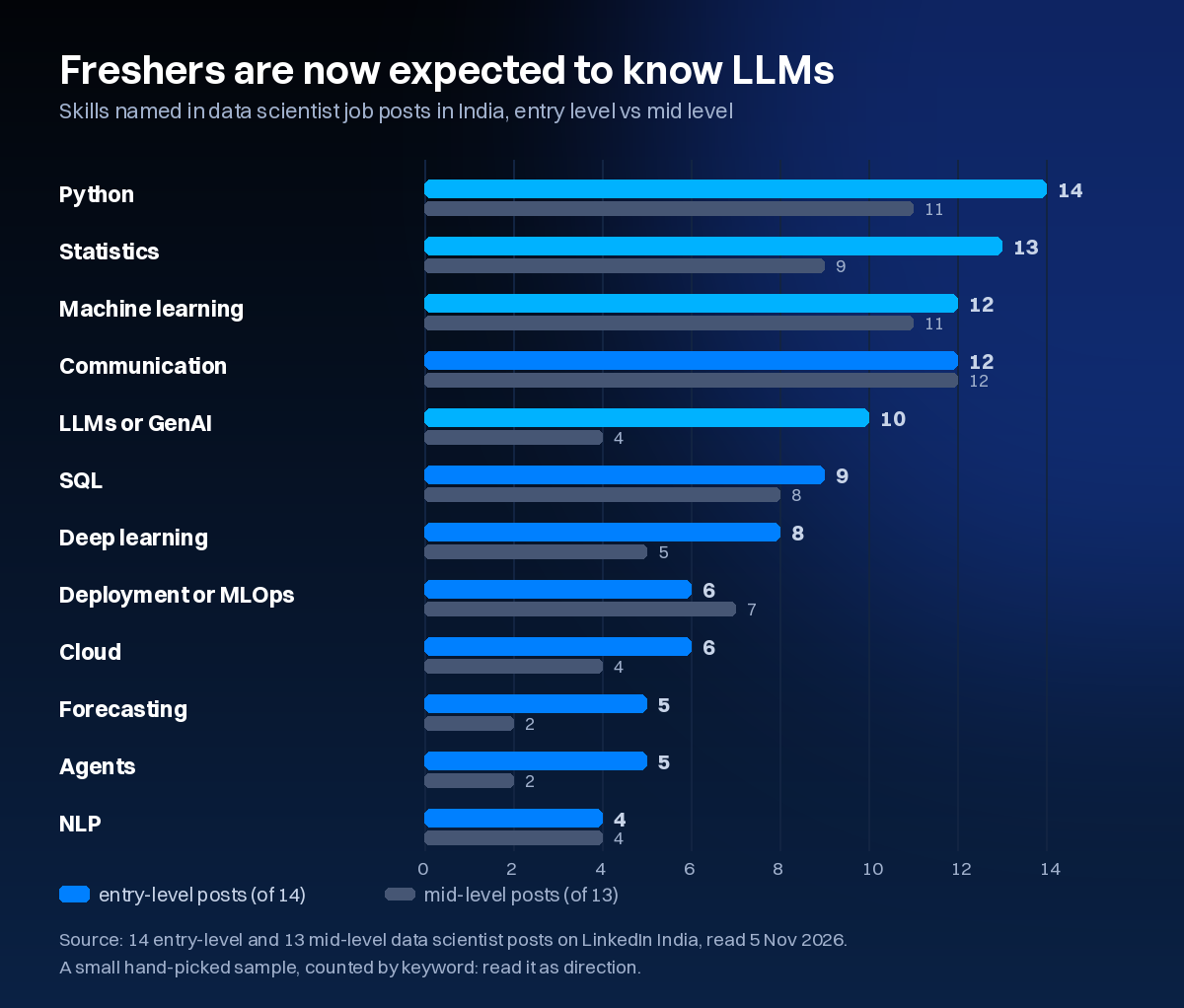
| Skill | Entry-level posts (of 14) | Mid-level posts (of 13) |
|---|---|---|
| Python | 14 | 11 |
| Statistics or a quantitative degree | 13 | 9 |
| Classical machine learning | 12 | 11 |
| Communication with stakeholders | 12 | 12 |
| LLMs or generative AI | 10 | 4 |
| SQL | 9 | 8 |
| Deep learning | 8 | 5 |
| Deployment or MLOps | 6 | 7 |
| Cloud (AWS, Azure, GCP, Databricks) | 6 | 4 |
| Forecasting or time series | 5 | 2 |
| Agents or agentic workflows | 5 | 2 |
| NLP | 4 | 4 |
| Monitoring or drift | 4 | 4 |
| A/B testing or experimentation | 3 | 2 |
| Recommender systems | 3 | 2 |
| Spark or PySpark | 2 | 4 |
This is a small sample of 27 posts that I picked and read by hand, mostly from Bengaluru, Gurugram and Pune, and the counts come from matching words in the posts. Treat it as direction, not a market share.
The most striking line is generative AI: 10 of the 14 entry-level posts mentioned LLMs or GenAI, more than the mid-level posts did. Employers hiring freshers in 2026 expect them to have built something with an LLM. The second is that the foundations have not moved. Python, statistics and machine learning are still in nearly every post, and SQL in most.
The syllabus, block by block
1. Python, SQL and statistics
Python with Pandas, SQL up to joins, window functions and CTEs, and the statistics that let you tell a real effect from noise: distributions, sampling, confidence intervals, hypothesis tests and how to design an A/B test with enough data to answer the question. Learn Git in the first week. It costs an afternoon, and every team uses it.
2. Machine learning, evaluated honestly
Feature engineering, linear and logistic regression, trees, random forests and gradient boosting (XGBoost or LightGBM), clustering, and the part that separates juniors from people others rely on: cross-validation, leakage, imbalanced classes and the right metric for the business problem. Add SHAP to explain a model's predictions, which lenders and insurers ask for, and one recommender case study, because three of the entry-level posts named recommendations.
3. Deep learning in PyTorch
Neural networks, CNNs for images, sequence models and transfer learning. Learn it in PyTorch. On 5 November 2026 the Hugging Face model hub had 262,067 models tagged PyTorch and 17,486 tagged TensorFlow. Keras 3 now runs on JAX, TensorFlow or PyTorch, so if you already know Keras, it still carries over.
Want to know what you are worth with these skills? Our data science salary calculator gives a directional range for your role, experience and city in under a minute.
Open the salary calculator4. NLP through embeddings and transformers
Start with a TF-IDF baseline so you know what a simple method scores, then move to embeddings and transformer models for classification, sentiment and extraction. Most real text work in 2026 starts from a pretrained transformer, not from hand-built features.
5. LLMs, retrieval and evaluation
This is the block that changed most in two years. Learn how transformers and attention work, then build a retrieval system (RAG) over your own documents and, just as important, measure it: does it retrieve the right passage, and is the answer faithful to it? Build a small labelled test set and score against it. Add tool calling, and learn when fine-tuning with LoRA is worth the effort. Mastercard's Data Scientist I post names RAG pipelines, Model Context Protocol integrations, fine-tuning and "hallucination detection". American Express asks for "model/AI evaluation". Both are entry-level roles.
Checking the model's output is the skill, not an extra. In the Stack Overflow Developer Survey 2025, 84% of respondents were using or planning to use AI tools, and 46% actively distrusted the accuracy of what those tools produce.
6. Forecasting
Decomposition and ARIMA/SARIMA, then gradient boosting with lag features and honest backtesting. Five of the 14 entry-level posts named forecasting, including TriNet, Ohmium and Concentrix, whose role is titled "Analyst Forecasting/Data Scientist".
7. Deployment and MLOps basics
Serve a model with FastAPI, put a Streamlit front end on it, package it with Docker, track experiments and versions in MLflow, and watch for drift once it is live. Add one hosted workflow on a cloud platform such as Databricks, since six entry-level posts named cloud. A model someone else can call is worth more than a notebook.
8. A capstone you deploy and defend
One problem, end to end: the business question, the data, the model, an honest evaluation, a deployed version and a presentation to someone who asks hard questions. This is what you talk about in interviews.
Why is it worth learning now?
Because employers in India expect these roles to grow quickly. In the World Economic Forum's Future of Jobs Report 2025, Indian employers expected net growth of 54% for data analysts and scientists between 2025 and 2030, against 41% globally, and 176% for AI and machine learning specialists. These are employer expectations from a survey, not a count of openings, but the entry-level posts above point the same way.
Is a ₹1,30,000 data science course worth it for you?
Answer five questions. You see the result straight away; nothing is stored.
- 1. Have you tried learning on your own and stalled part-way?
- 2. Do you want a live instructor you can ask questions?
- 3. Do you need someone to review your projects and give feedback?
- 4. Are you trying to switch careers (not just add a skill)?
- 5. Do you need help preparing for interviews?
What we changed in our own syllabus on 5 November 2026
After reading these posts, we updated seven of our eight modules. No module's hours changed.
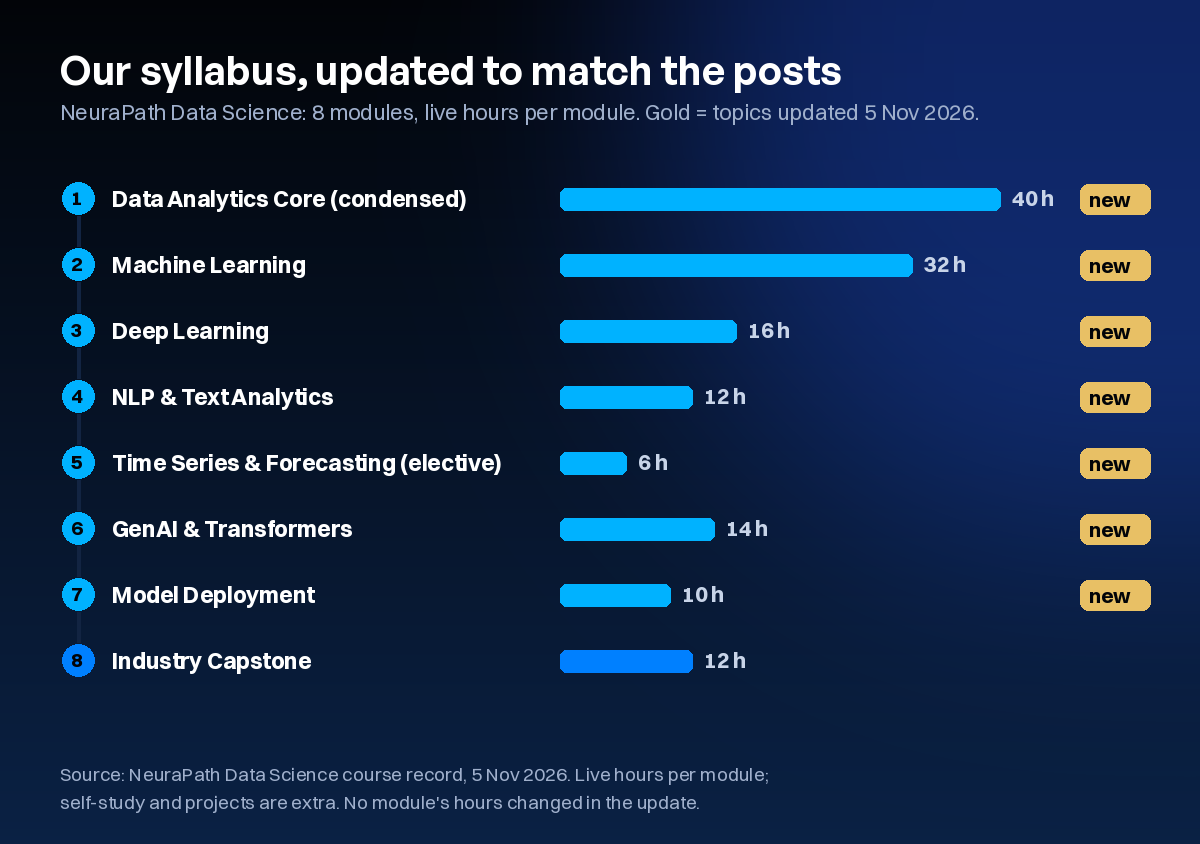
| Module | Live hours | What changed on 5 Nov 2026 |
|---|---|---|
| Data Analytics Core (condensed) | 40 | Added A/B test design (power and sample size) and Git from week one |
| Machine Learning | 32 | Added LightGBM, SHAP explanations and a recommender case study |
| Deep Learning | 16 | Now taught PyTorch-first, with Keras 3 optional |
| NLP & Text Analytics | 12 | Moved from classic text processing to embeddings and transformer models |
| Time Series & Forecasting (elective) | 6 | Added SARIMA, gradient boosting with lag features and backtesting |
| GenAI & Transformers for Data Scientists | 14 | Now builds and evaluates a RAG system (retrieval hit rate, faithfulness, a labelled test set), with tool calling and when to fine-tune |
| Model Deployment | 10 | Added MLflow tracking and model registry, drift monitoring and one hosted workflow on Databricks Free Edition |
| Industry Capstone | 12 | No change |
Each change traces back to the posts above. RAG and evaluation because 10 of 14 named LLMs. MLflow and drift because six named deployment and four named monitoring. PyTorch because that is where the models are.
Our Data Science programme, and who it is not for
I teach it myself, with Ishaan Sharma, a Senior Data Scientist at Nuvo AI (Meril Group). It runs for six months, taught live online by working practitioners, with optional classroom labs at our Noida centre, and every session is recorded. Every module ends in a project, from churn and fraud models to an evaluated RAG assistant and a model you deploy behind an API, and the capstone is presented on demo day.
The fee is ₹1,30,000 (inclusive of GST) · EMI from ₹5,000/month. Eligible learners are covered by our job guarantee with minimum package assurance, or 50% of the fee back, for those meeting the attendance, deliverable and capstone criteria. Terms and conditions apply. The conditions are in our job guarantee terms: at least 70% in every assessment, at least 80% live attendance, four or more logged applications a week, fees settled, and attending the interviews we arrange, within six months of certification.
For pay at each level, read our data scientist salary guide. For where freshers get hired, see data scientist jobs for freshers.
Who this is not for
- People who mainly want reporting and dashboard work. Our data analyst syllabus covers that path, in less time and for less money.
- People who cannot give it six months of steady weekly hours.
- People who want to skip the statistics. Interviewers test it, and models without it fail quietly.
What to do this week
- 1Open five data scientist posts that say "fresher", "entry level" or "0 to 2 years" in the city you want, and list every skill they name. Compare your list with the table above.
- 2Pick one project you have, or start one, and add an honest evaluation: a held-out test set, the right metric and one paragraph on where the model fails.
- 3Build the smallest possible RAG: ten documents, one question, and a check of whether the answer matches the source.
- 4Run your CV through our free skill check to see which data scientist requirements you already meet.
Still unsure whether data science is right for you?
Send us your current qualification or role and what you are trying to achieve. We pass it to one of our instructors, who are working data scientists, and reply with the skills you would need and whether a structured course makes sense for you at all.
Sources
- TriNet: Associate Data Scientist, Hyderabad (LinkedIn)
- PwC India: Associate, Data Science & Engineering, Kolkata (LinkedIn)
- American Express: Analyst-Data Science, Gurugram (LinkedIn)
- Mastercard: Data Scientist I, Pune (LinkedIn)
- Bureau: Associate Data Scientist, Bengaluru (LinkedIn)
- Hugging Face: models filtered by library, PyTorch and TensorFlow
- Keras: Getting started (Keras 3 backends)
- World Economic Forum: Future of Jobs Report 2025 (India economy profile, p. 148)
- Stack Overflow Developer Survey 2025: AI
Frequently asked questions
What is the syllabus of a data science course in 2026?
Python, SQL and statistics; data wrangling and exploratory analysis; machine learning with proper validation; deep learning in PyTorch; NLP through embeddings and transformers; working with LLMs, including retrieval (RAG) and evaluating its output; and deploying a model with tracking and monitoring. It should end in a capstone you deploy and defend.
Can a fresher get a data scientist job in India?
Yes. On 5 Nov 2026 we read entry-level data scientist posts that welcome freshers, including TriNet's Associate Data Scientist (0 to 1 year, 'fresh graduates encouraged to apply') and PwC India's Associate, Data Science & Engineering ('Fresher / 0 to 2 Years'). American Express and Mastercard also list entry-level data science roles.
Do data scientists need to learn generative AI now?
Yes, at the level of using LLMs well. In 14 entry-level posts we read, 10 mentioned LLMs or generative AI. Mastercard's Data Scientist I post names RAG pipelines and hallucination detection; American Express asks for coursework or project experience with LLMs.
Should I learn PyTorch or TensorFlow?
PyTorch first. On the Hugging Face model hub on 5 Nov 2026, 262,067 models were tagged PyTorch and 17,486 TensorFlow. Keras 3 now runs on JAX, TensorFlow or PyTorch, so Keras skills still carry over.
Is maths required for data science?
Enough statistics, probability and linear algebra to understand what a model does and whether a result is real. 13 of the 14 entry-level posts we read named statistics or a quantitative degree. You do not need a maths degree to start.
How long does a data science syllabus take to complete?
About six months of structured study if you already know some analysis, or longer from scratch. Our programme runs for six months, live and mentor-led, and ends with a deployed capstone.
Pankit Kumar has 10 years in Data Science & AI, building and shipping production systems in regulated pharma and clinical environments. He is a freelance trainer at Boston Institute of Analytics, AnalytixLabs and Scaler, and has taught this material to thousands of working professionals.
This article is part of our Data Science programme — 6 months. From data foundations to machine learning, deep learning and deployment.
Explore Data Science