Data scientist jobs for freshers in India: how to get hired
In this article (8 sections)
- Do companies in India hire freshers as data scientists?
- How many entry data science roles actually take freshers?
- What do fresher data scientist interviews test?
- How do I compete for a fresher data scientist job?
- What does a fresher data scientist earn in India?
- Is NeuraPath's Data Science programme right for a fresher?
- Who this is not for
- What to do this week
Related programme: the Data Science course (6 months; ₹1,30,000 (inclusive of GST) · EMI from ₹5,000/month).
Yes. Freshers are hired as data scientists in India, usually under titles like Associate Data Scientist, Junior Data Scientist, Data Scientist I or Trainee Decision Scientist. On 18 Oct 2026 I read 17 live India postings with those titles: four took 0 years of experience outright, one set no minimum, and four more counted internships, research or project work as experience. Expect around ₹6 lakh a year to start. What gets you hired is proof: SQL, Python, statistics, a model you can explain, and one project framed as a business problem.
Want to know how your CV reads against data scientist roles today? Run the free resume check. It takes about five minutes.
A question that reaches our admissions WhatsApp goes something like this: "For data science, do I first have to learn the basics of data analytics?" Behind it sits a bigger worry. You have a B.Tech, a B.Sc, a B.Com or a BA, or you are coming back after a break, and you want to know whether a company will hire you, a fresher, as a data scientist.
You are far from alone. Of the 76 people who booked a seat at our Data Science masterclass in September 2026, 22 described themselves as having 0–1 years of experience. So here is what I tell them: where freshers get hired, under which titles, what the interviews test, what the pay looks like and how to compete. I'm a Senior Data Scientist at Parexel with about ten years in the field, and I lead NeuraPath's Data Science programme.
Do companies in India hire freshers as data scientists?
They do, and you can see it in live postings. I went looking for proof rather than relying on my own impression. On 18 Oct 2026 I read every India posting I could find with an entry-level data scientist title, on the employer's own LinkedIn post or careers site. These are the clearest ones:
- TriNet, Hyderabad, Associate Data Scientist (posted 15 Oct 2026): "0–1 year experience (fresh graduates encouraged to apply)", with "academic or internship experience in analytics/data science" as a plus.
- United Airlines India Knowledge Center, Gurugram, Associate Data Scientist (posted 1 Oct 2026): "full time or internship experience in analytics/data science", 0–3 years.
- Accenture, Bengaluru, Data Science Associate 2 (on Accenture's careers site, posted 12 Oct 2026): 0–2 years "in AI/ML, data science, software engineering, analytics, or related fields".
- TE Connectivity, Bengaluru, Data Scientist I (posted 16 Oct 2026): 0–3 years of experience in data science, analytics, machine learning or AI-related projects.
- Mastercard, Pune, Data Scientist I (on Mastercard's careers site, posted 9 Oct 2026): no minimum years stated, a computer science degree or equivalent, and a demanding GenAI skill list.
And one employer built around freshers: Mu Sigma's careers page describes Trainee Decision Scientist and Decision Scientist roles for students and recent graduates, hiring "across engineering streams (BTech/BE)". Selection runs through an aptitude assessment, an AI-bot interview and a problem-solving case study.
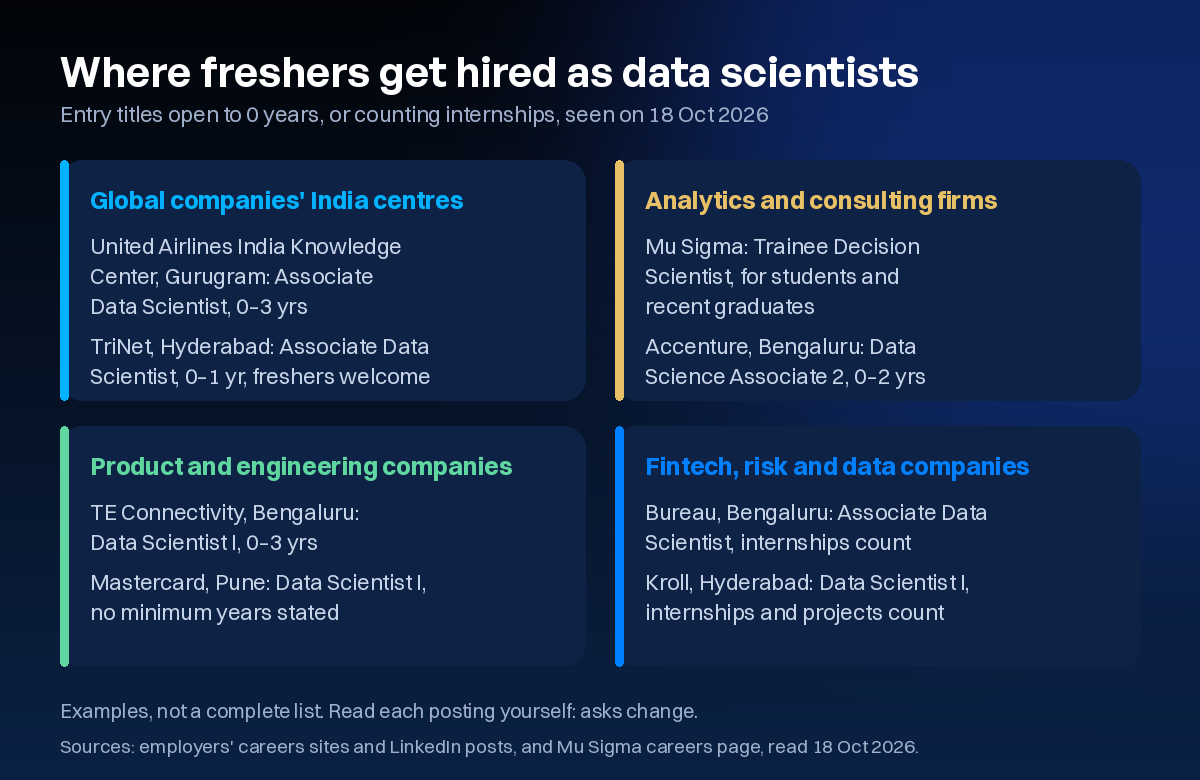
Two things stand out. Global companies' India centres, often called GCCs, are a real door: United Airlines' Gurugram centre is right here in Delhi NCR. And "experience" is read generously. Kroll's Data Scientist I in Hyderabad asks for 1–3 years, then adds "internships, co-ops, research, and strong project work all count". Bureau, a Bengaluru fintech, says the same of "internships with real shipped work". Your internship and your portfolio are your experience line.
How many entry data science roles actually take freshers?
More than you might fear. Of the 17 entry-titled postings I read, here is how the experience asks split:
| What the posting asked | Postings | Examples |
|---|---|---|
| Takes 0 years | 4 | TriNet, United Airlines India Knowledge Center, Accenture, TE Connectivity |
| No minimum stated | 1 | Mastercard |
| Counts internships, research or projects, or welcomes recent graduates | 4 | Bureau, Kroll, SAP, Arcadia |
| Wants 2 years or more | 8 | Trinity Life Sciences (2), PwC (2), Metyis, DTCC, ZIGRAM, Amgen |
Source: 17 India postings titled Associate Data Scientist, Junior Data Scientist or Data Scientist I, read on the employers' own LinkedIn posts or careers sites on 18 Oct 2026. A sample I could read in full, not a count of the market.
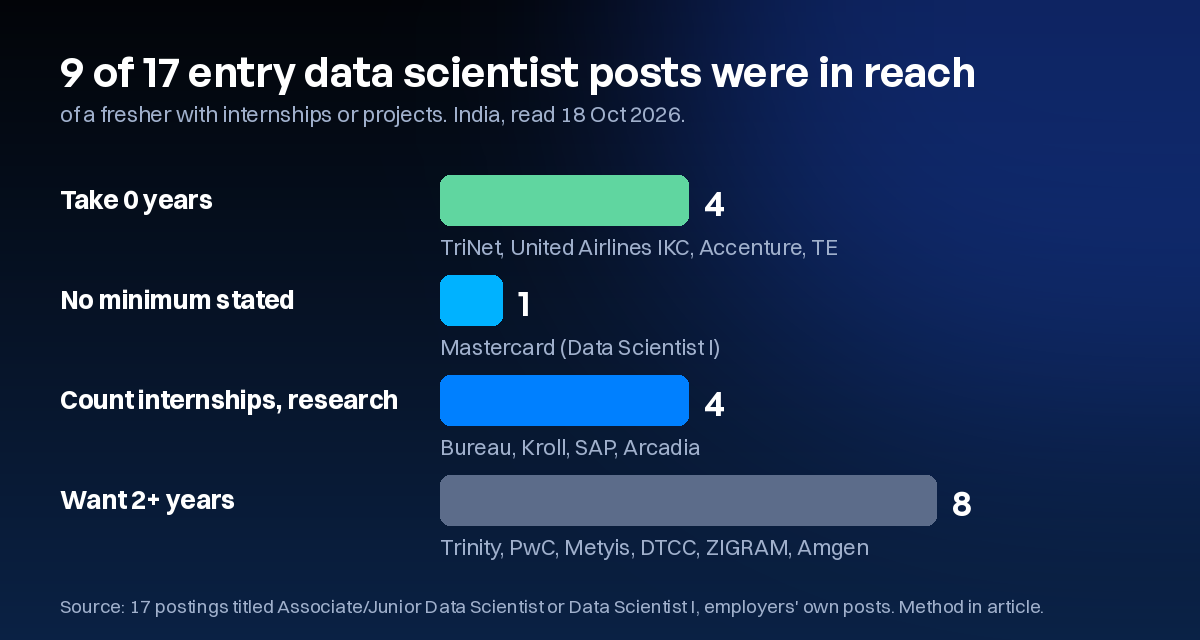
So 9 of 17 were in reach of a fresher who has done an internship or built real projects. The other 8 used an "Associate" title for a 2–6 year role, which is common at consulting firms. Read the experience line before you spend an evening on a cover letter.
A side note on job boards. Earlier the same day I pulled every India data posting from the public Greenhouse, Lever and Ashby boards of 15 product and AI companies (Meesho, Paytm, Sarvam, Coinbase and others): 53 postings, and the lowest ask on those boards was 2 years. That tells you about experienced hiring at those firms, not about freshers. Campus drives, trainee intakes and many startup roles rarely appear on boards like these, so if you only search there, you will miss many of the doors in this article.
The wider market is moving your way. Naukri's JobSpeak index for September 2026 shows AI/ML roles up 20% on a year earlier. TeamLease EdTech's outlook for July–December 2026, as reported by The Hans India on 12 Aug 2026, puts overall fresher hiring intent at 75%, up from 73% in the first half.
Want the module-by-module plan, from SQL and statistics through machine learning, deep learning, NLP and deployment, with the project that ends each module?
See the Data Science syllabusWhat do fresher data scientist interviews test?
The same handful of things, in nearly every posting and interview I see. In rough order of how often freshers trip on them:
- 1SQL under time pressure: joins, group-bys, window functions, and getting the grain of a table right.
- 2Python for data: pandas, cleaning messy columns, and writing a function someone else can read.
- 3Statistics you can explain: why a difference might be noise, what a confidence interval says, why a correlation in a dashboard is not a cause.
- 4Machine learning, with the weight on evaluation. Anyone can call
fit(). Interviewers ask why you chose that metric, what your validation split leaked, and what happens on imbalanced data. - 5One project told as a business problem: what decision it supports, what data was messy, what you would do next. A churn model that says "call these 200 customers first, and here's the expected saving" beats ten tutorial notebooks.
- 6Working with AI tools. TeamLease EdTech's founder told The Hans India that employers in IT and consulting now expect freshers to show "AI fluency, applied problem-solving, and hands-on project experience from day one". In practice that means using an assistant to write and check code and SQL, and being able to say when its answer is wrong.
Entry postings add their own flavour. Mastercard's Data Scientist I wants retrieval-augmented generation and LLM evaluation; TE Connectivity's sits in manufacturing analytics. Read three postings for the kind of company you want and you will see which of the six to go deep on.
How do I compete for a fresher data scientist job?
With evidence a recruiter can open in two minutes. This is what I would build in your place.
A small portfolio of two or three projects, each with a short README that starts with the business question. One should be a classic supervised model (churn, credit risk, demand), one should involve messy real data you cleaned yourself, and one can use text or an LLM. Put them on GitHub with clean notebooks and a two-paragraph summary at the top.
Kaggle-style practice, used properly. Competitions teach you feature engineering and honest validation fast. Don't list ranks; write up what you tried, what failed and why your final validation score is believable.
An internship, even a short one. Several of the postings above count "internships with real shipped work" as experience. A 3–6 month data internship at a startup, where something you built is used by someone, is worth more than another certificate.
Your domain. If you studied commerce, worked in sales operations or spent time in a lab, pick projects there on purpose. A B.Com graduate who can model invoice delays or credit risk brings context a generic candidate lacks, and a hiring manager in that function notices.
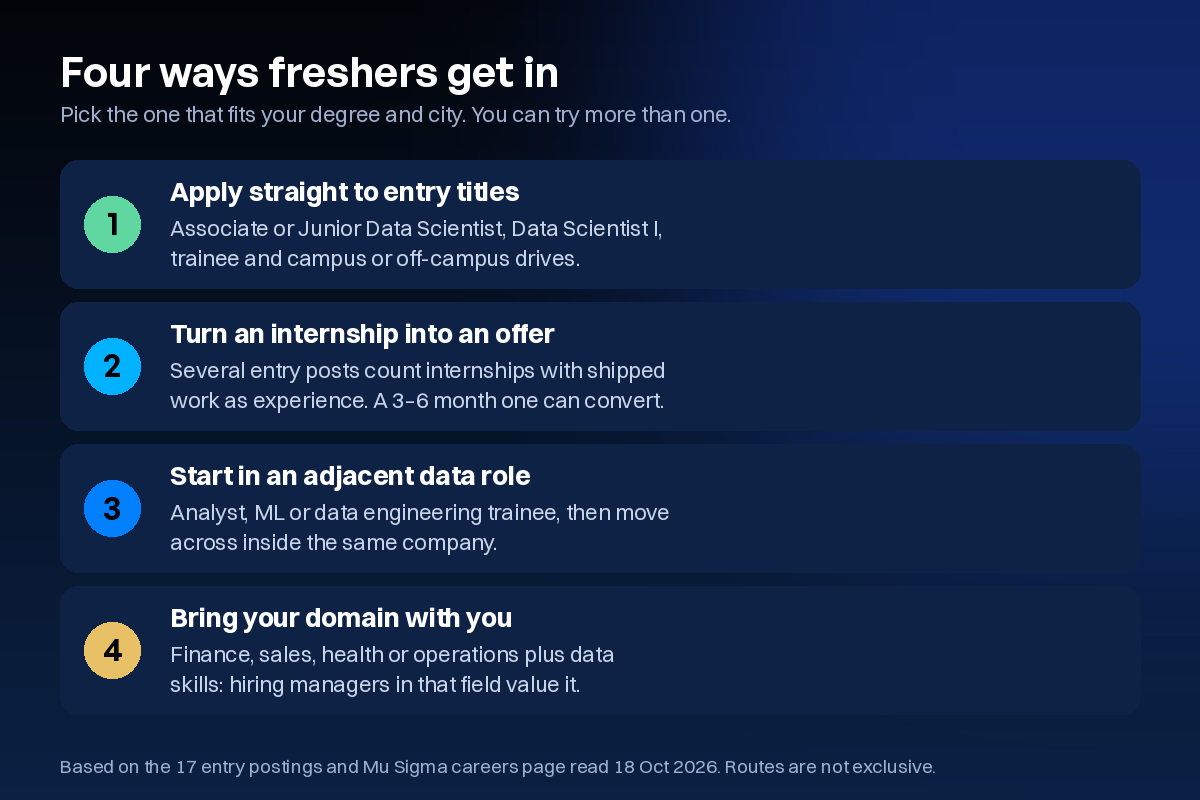
There are four ways in, and you can work on more than one at once. Apply straight to entry titles and drives. Turn an internship into an offer. Start in an adjacent data role, such as analyst or data engineering trainee, and move across inside the company. Or bring your domain with you. For how the analyst and data scientist roles compare day to day, see data scientist vs data analyst.
If you are a non-CS graduate, your degree subject is rarely what filters you out; a thin portfolio is. If you are returning after a break, don't hide the gap and don't apologise for it. Put a dated, recent project at the top of your CV so the first thing a recruiter sees is current work.
What does a fresher data scientist earn in India?
Around ₹6 lakh a year on average, and it rises quickly with experience.
| Experience | Average total compensation | Based on | Source |
|---|---|---|---|
| Under 1 year | ₹5,95,255 a year | 307 salaries | Payscale India, updated 9 Jul 2026 |
| 1–4 years | ₹10,05,147 a year | 754 salaries | Payscale India, updated 9 Jul 2026 |
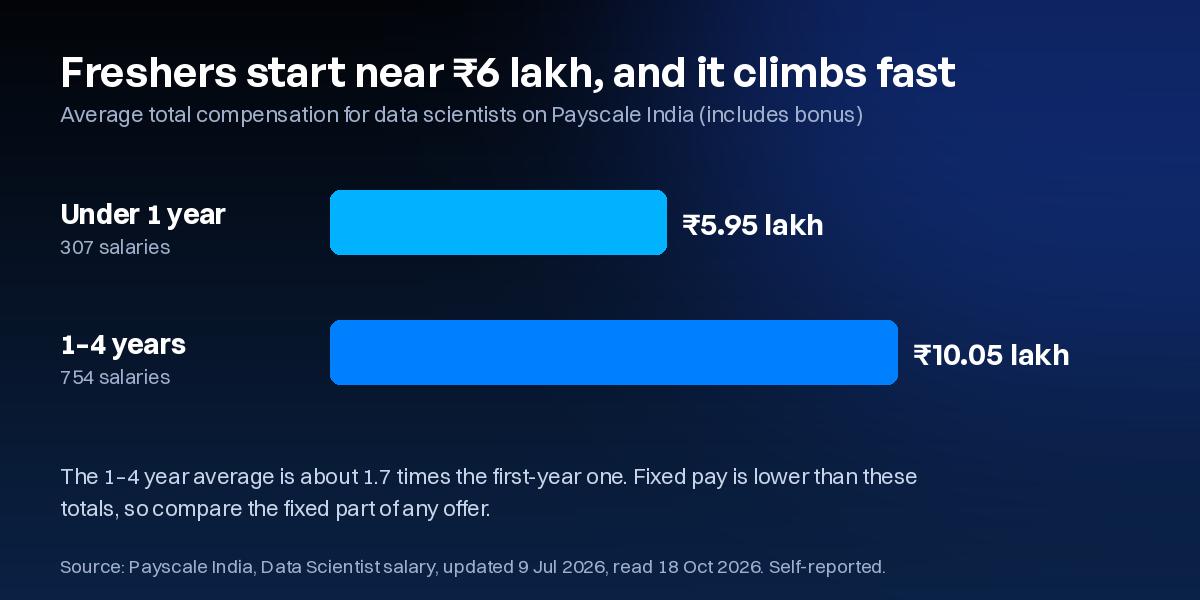
*Self-reported. Total compensation includes bonus, so it is higher than fixed pay. A single average hides a wide spread between employers and cities.*
Two things to know before you compare an offer with these figures. First, fixed pay and CTC are different numbers. CTC usually includes the employer's provident fund contribution, gratuity and any variable or joining bonus, so your monthly in-hand pay is noticeably smaller than CTC divided by twelve. Compare the fixed component. Second, the 1–4 year average is about 1.7 times the first-year one. Pick the first job for the work it puts in front of you; the pay follows the experience. For pay by city and skill beyond the first few years, see our data scientist salary guide.
Is NeuraPath's Data Science programme right for a fresher?
It was built for freshers and early-career learners, so for many of you, yes.
The Data Science programme runs 6 months, live and mentor-led. It is taught live online by working practitioners, with optional classroom labs at our Noida centre. I teach it. Back to that WhatsApp question: the first module is a condensed 40-hour data analytics core (Excel, SQL, Power BI, Python, EDA and statistics), because those are what every fresher interview opens with. Then it moves through machine learning (feature engineering, tree models, XGBoost, clustering, validation and imbalanced data), deep learning, NLP, a GenAI module on transformers and retrieval for data scientists, and model deployment. You build churn, segmentation and fraud models, a review-mining NLP project and a deployed ML model with an API and a simple interface, and you finish with a capstone you present on demo day, followed by a viva. Those are portfolio projects you can talk through in an interview, end to end.
The fee is ₹1,30,000 (inclusive of GST) · EMI from ₹5,000/month.
Eligible learners are covered by our job guarantee with minimum package assurance, or 50% of the fee back, for those meeting the attendance, deliverable and capstone criteria. Terms and conditions apply. In plain terms the conditions are: at least 70% in every assessment, at least 80% live attendance, at least four logged job applications every week, fees settled, and attending the interviews we arrange, all within six months of certification, with any claim made within 21 days after that window. The minimum package and the full conditions are in our published terms.
Who this is not for
If you want a data scientist title within three months, this is the wrong spend; six months of learning plus a job search takes longer than that. If you cannot give it around 15 hours a week for six months, live classes plus practice and projects, wait until you can. If you want to skip SQL and statistics and go straight to deep learning, you will find the first two months slow, and they are the part interviews test hardest. And if you are a senior professional with ten or more years in another field, talk to us before enrolling; the programme is pitched at people early in their careers.
What to do this week
- 1Search LinkedIn and employers' careers pages for "Associate Data Scientist", "Junior Data Scientist", "Data Scientist I" and "trainee" in your city. Save five postings that take 0 years or count internships, and copy their requirement lines into one document.
- 2Mark what you can already show against those lines, and pick the two biggest gaps.
- 3Do one timed SQL exercise a day for five days, 20 minutes per question.
- 4Start one project in a domain you know and write its one-paragraph business problem before any code.
- 5Apply to at least one data internship or trainee drive this week. If you want a second opinion on which first role suits your degree, request the callback below.
Frequently asked questions
Can a fresher get a data scientist job in India?
Yes. Look for titles like Associate Data Scientist, Junior Data Scientist, Data Scientist I and Trainee Decision Scientist. On 18 Oct 2026, TriNet (Hyderabad), United Airlines India Knowledge Center (Gurugram), Accenture (Bengaluru) and TE Connectivity (Bengaluru) all had entry data science postings that accepted 0 years of experience.
What is the salary of a fresher data scientist in India?
Payscale India (updated 9 Jul 2026) reports an average total compensation of ₹5,95,255 a year for data scientists with under one year of experience, from 307 self-reported salaries. Total compensation includes bonus, so fixed pay is lower. The 1–4 year average is ₹10,05,147.
Which companies hire freshers as data scientists?
Global companies' India centres, analytics and consulting firms, product and engineering companies, and fintechs. Examples from postings read on 18 Oct 2026 include TriNet, United Airlines India Knowledge Center, Accenture, TE Connectivity and Mastercard, and Mu Sigma hires students and recent graduates as Trainee Decision Scientists. Hiring changes month to month, so check each careers page.
Do internships count as experience for data scientist jobs?
Often, yes. Kroll's Data Scientist I posting says "internships, co-ops, research, and strong project work all count", and Bureau's Associate Data Scientist posting counts "internships with real shipped work".
Should I learn data analytics before data science?
Learn the analytics core first, as part of data science rather than instead of it. SQL, Python for analysis, a BI tool and statistics are what fresher interviews open with, and they make the machine learning that follows easier to use well.
Can a B.Com or BA graduate become a data scientist?
Yes. Employers filter on skills and proof of work far more than degree subject for these roles. A commerce or arts graduate who learns SQL, Python, statistics and machine learning, and builds projects in a domain they understand, competes well.
Pankit Kumar has 10 years in Data Science & AI, building and shipping production systems in regulated pharma and clinical environments. He is a freelance trainer at Boston Institute of Analytics, AnalytixLabs and Scaler, and has taught this material to thousands of working professionals.
This article is part of our Data Science programme — 6 months. From data foundations to machine learning, deep learning and deployment.
Explore Data Science