Data analytics course fees in India (2026), compared
In this article (14 sections)
- How much does a data analytics course cost in India?
- What does each price range usually buy?
- Which kind of course suits you: self-paced, large cohort or mentored?
- Is GST included in data analytics course fees?
- Why do data analytics course fees differ so much?
- How do I compare cost per live hour?
- Should I pay for a data analytics course in EMI?
- Is a free data analytics course enough to get hired?
- Which route is right for you?
- Before you pay for a data analytics course, ask these 10 questions
- Our Data Analytics programme, and who it is not for
- Who this is not for
- What to do this week
- Sources
Related programme: the Data Analytics with Generative AI course (3–4 months; ₹90,000 (inclusive of GST) · EMI from ₹4,000/month).
In short: published data analytics course fees in India run from Google's self-paced certificate at US$20 a month to ₹1,60,000 for Coding Ninjas' programme with Vishlesan i-Hub, IIT Patna. Most live, multi-month programmes sit between about ₹47,000 and ₹90,000 once GST is added. Every figure here was read on the provider's own page on 2 Nov 2026. Compare them on live hours, who reviews your work and the full EMI total, not on the headline number.
I am Pankit Kumar. I lead the Data Analytics programme at NeuraPath and work as a Senior Data Scientist at Parexel. Fees come up in almost every counselling call we have. This autumn several people told us our fee was more than they could manage; one wanted something in the ₹2,000 to ₹3,000 range, another said they would discuss it with family first, and one asked to see every course and placement document in writing before paying anything. All three are reasonable. So I opened the fee pages of the courses people mention most and put the numbers side by side. I teach one of these programmes, so I am a seller here too, and our fee is in the table with the rest.
How much does a data analytics course cost in India?
Anywhere from free to about ₹1.6 lakh. Most structured live courses with projects land between ₹47,000 and ₹90,000 including GST.
| Provider and programme | Fee as published | GST | Length and format | Refund terms published |
|---|---|---|---|---|
| Google Data Analytics Certificate (on Coursera) | US$20 a month after a 7-day free trial (India price) | Billed by Coursera; tax at checkout | 8 courses, 240 hours, self-paced; "many learners complete" in 3 to 6 months | Not in what we read |
| PW Skills, Data Analytics With AI | ₹6,999 Basic, ₹19,999 Premium, ₹29,999 Pro | Not stated | 7 months; recorded lessons plus live revision sessions | Not in what we read |
| AnalytixLabs, Data Analyst course (Gurgaon page) | ₹47,200 blended, ₹53,100 live online, ₹61,360 classroom, "including taxes". The same page also lists ₹53,100 to ₹87,320 depending on certification partner and mode | Inclusive for the first three figures; not stated for the others | About 5 months | Not in what we read, beyond its guarantee terms |
| Masai with E&ICT Academy, IIT Roorkee: Certification Program in Data Analytics with AI and Gen AI | ₹57,000 + GST (₹4,000 registration + ₹53,000 programme), plus a ₹99 application fee | ₹63,260 upfront, inclusive of GST | 6 months, weekdays 8 to 10 PM online | "As per our Refund & Withdrawal Policy" (separate page) |
| NeuraPath, Data Analytics with Generative AI | ₹90,000 · EMI from ₹4,000/month | Inclusive of GST | 118 live hours: 2 months on weekdays or 3 to 4 months on weekends | In your written enrolment terms |
| Coding Ninjas with Vishlesan i-Hub, IIT Patna: Professional Certification in Data Analytics with GenAI | ₹1,60,000 | Not stated | 6 months, live online | Full refund within 7 days of batch start; page said enrolments were closed |
Every figure as printed on the provider's own page, read 2 Nov 2026. PW Skills' prices come from its own launch post for the 17 January 2026 batch. "Not in what we read" means we did not find it on that page, not that no policy exists. Fees change, so confirm on the day you pay.
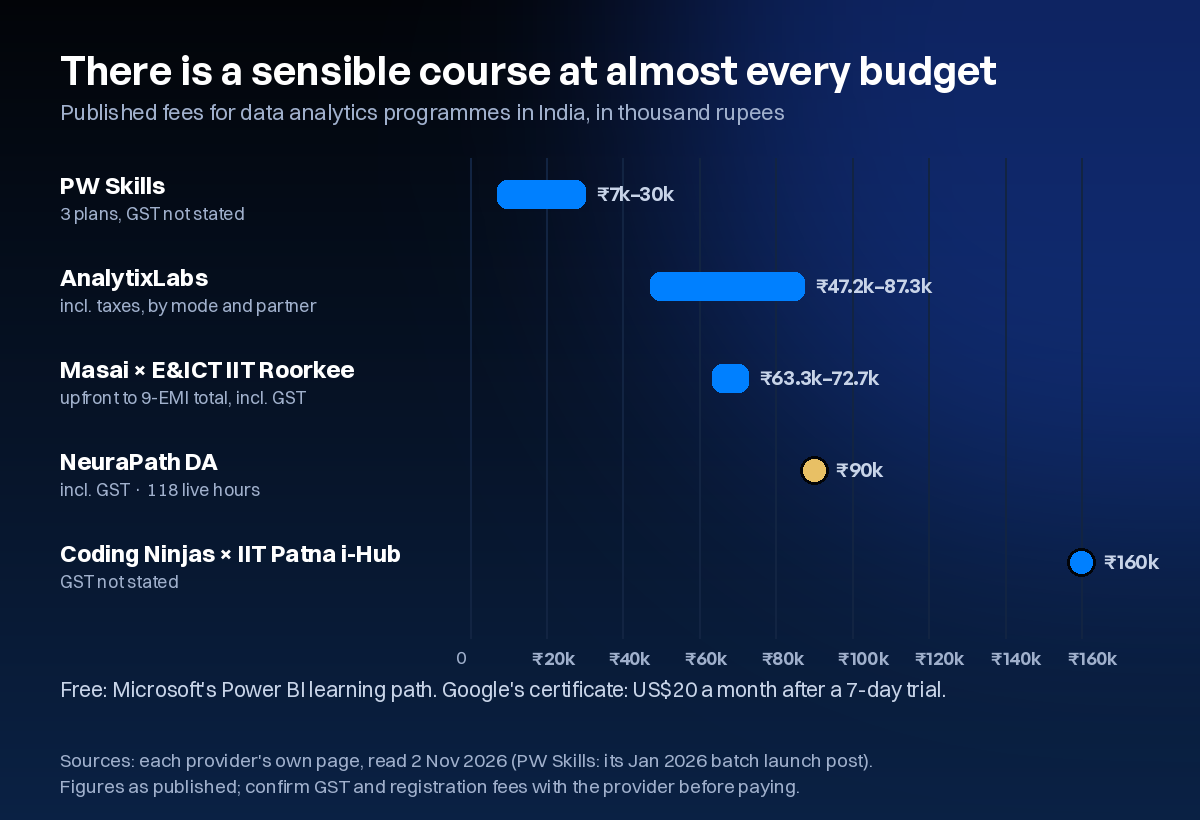
Two notes, neither of them a criticism. AnalytixLabs' page shows two sets of figures for what looks like the same course, so ask them which one applies to the batch and mode you want, in writing. And Coding Ninjas' page did not say whether ₹1,60,000 includes GST; at 18% that is a difference of ₹28,800, so it is worth one question.
Confused between these programmes?
Tell us the two or three data analytics courses you are considering. One of our mentors will compare them for you on curriculum, live hours, projects, placement terms and the total you would actually pay, even if NeuraPath is not the right option.
- · Name and WhatsApp number only
- · A written comparison on WhatsApp within one working day
- · No obligation to enrol anywhere
What does each price range usually buy?
Grouping the table by price makes the trade-off easier to see. These are patterns in what the providers above publish, not rules, so check the specific course.
| Price range (GST-inclusive) | What you usually get | Check before paying |
|---|---|---|
| Free | Good material for every individual skill: Excel, SQL, Power BI, Python. No schedule, no review | Whether you will actually finish. Microsoft's Power BI learning path and Google's 7-day trial cost nothing to start |
| Under ₹30,000 | Mostly recorded lessons, some live revision or doubt sessions, a certificate | How many live hours there really are, and whether anyone reads your projects |
| ₹45,000 to ₹65,000 | Live online cohorts over 5 to 6 months, projects, placement support | Live hours versus self-study hours, registration fees, and the refund window |
| ₹80,000 to ₹1,00,000 | More live hours, smaller batches, more individual review | Who reviews your work, how often, and the batch size |
| Above ₹1,00,000 | University or IIT-hub branding, longer support | Whether the brand on the certificate is worth the difference to the employers you want |
Which kind of course suits you: self-paced, large cohort or mentored?
The price ranges above map onto three ways of learning. None of them is better in general; each suits a different kind of learner.
| Self-paced | Large live cohort | Small mentored cohort | |
|---|---|---|---|
| Cost | Low | Medium | Higher |
| Live interaction | Little or none | Some, shared with many | A lot |
| Feedback on your projects | Limited | Varies by course | Regular, individual |
| Flexibility | High | Medium | Medium |
| Accountability | Low | Medium | High |
| Best for | Disciplined self-learners | People who want structure on a budget | Career switchers who need feedback and interview practice |
NeuraPath follows the small mentored cohort model, with batches of 15 to 20. That is why our fee sits where it does. If you are a disciplined self-learner, the left-hand column may be all you need.
What we hear on counselling calls: most people start by comparing the total fee. The questions that usually change their decision come later: how many hours are actually taught live, who will look at their work, and what the EMI adds up to.
Is GST included in data analytics course fees?
Sometimes. Training fees in India attract 18% GST, and providers print them either inclusive or as "+ GST". Convert everything to the final amount before you compare.
The gap is real money, and even careful pages can be confusing. Masai's page prints ₹57,000 + GST and, separately, ₹63,260 upfront inclusive of GST; 18% on ₹57,000 would come to ₹67,260, so ask them which figure your batch pays. On a ₹1,60,000 fee that does not mention GST, 18% would add ₹28,800. Where a page does not say, ask one direct question: "Is this the final amount I pay, including GST and any registration or application fee?" Our own fee, ₹90,000, already includes GST, and nothing is added at the end.
Why do data analytics course fees differ so much?
Mostly because of live teaching time and how much of your work a person actually reviews. Recorded video is cheap to deliver to thousands of people. A mentor reading your SQL every week is not.
When I look at a fee, these are the things I check, roughly in order of how much they move the price:
- Live hours with an instructor, and how many of the published hours are live versus self-study.
- Who reviews your dashboards and queries, and how often.
- Batch size. A class of 15 gets far more questions answered than a class of 150.
- What you build, and whether it ends up somewhere an employer can open it.
- Length. Six months costs more than two, though not in proportion.
- The name on the certificate. University and IIT-hub tie-ups usually cost more.
Review is where I would spend if I had to choose. One of our analyst lab exercises is built around a single trap: a SQL join that quietly counts some orders twice, so the revenue total still looks plausible but is wrong (the full exercise is here). You only learn to catch that when someone checks your answer against the right one, every week, until you start checking it yourself.
How do I compare cost per live hour?
Divide the GST-inclusive fee by the live hours the provider publishes. If a provider will not tell you the live hours, write that down too; it tells you something.
This is harder than it sounds, because few pages state live hours clearly. AnalytixLabs' page, for example, shows "500 Hours" in its header and "16 x 3 = 50 Hours" of classes plus 90 self-study hours further down. Masai publishes a weekday 8 to 10 PM slot and 8 to 10 hours a week of total commitment, but not live hours. Google's certificate is 240 hours, all self-paced. So the honest way is to ask each provider the same question and fill in the column yourself.
For our own programme the figure is simple to check: ₹90,000 for 118 live hours is about ₹763 per live hour. On top of those live hours there are about 20 hours of e-learning and about 210 hours of self-study and projects.
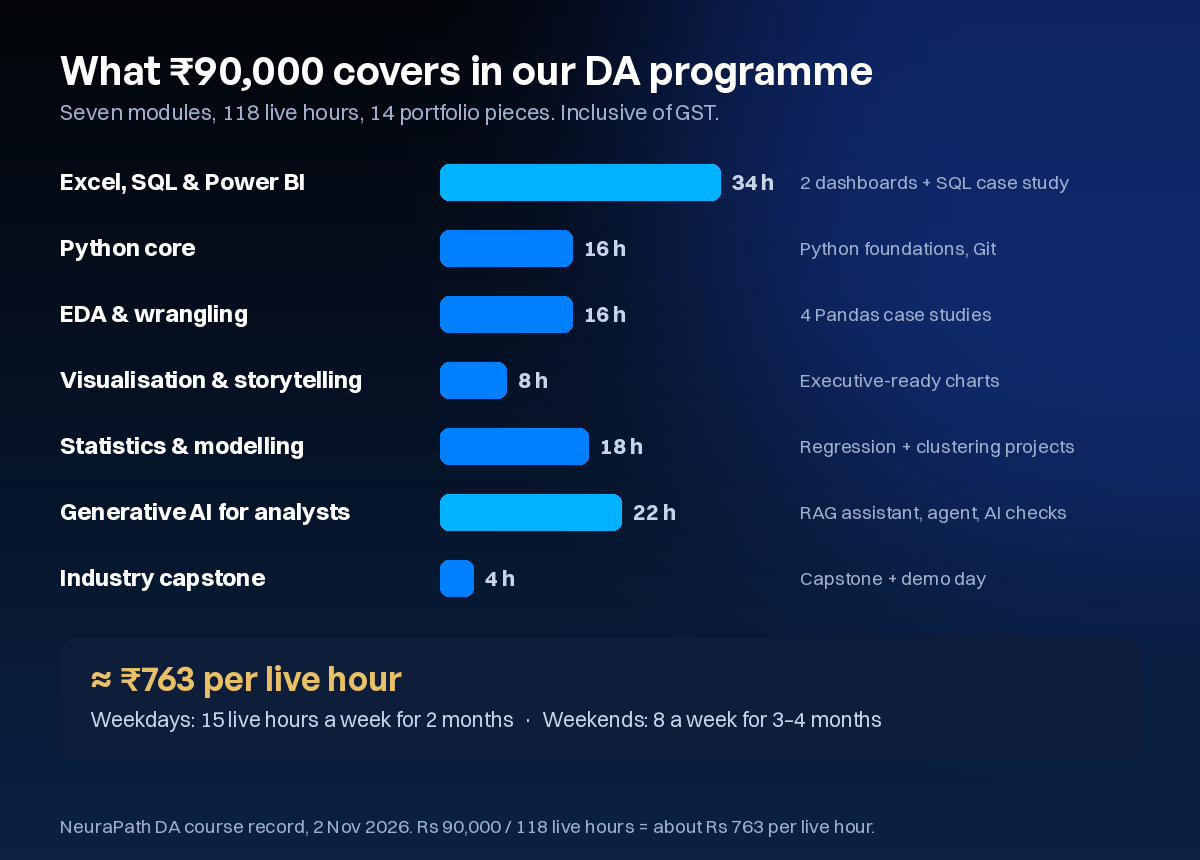
Cost per hour is a starting point, not a verdict. A cheap course with good recorded lessons is excellent value if you will do the work alone. It is not the same product as one where someone reviews your projects, and a per-hour figure cannot show that difference.
Should I pay for a data analytics course in EMI?
EMI is fine if you know the total before you sign. A monthly figure on its own tells you very little.
Masai's page is a good example of why, because it prints both numbers clearly: ₹63,260 upfront, or nine instalments of ₹8,083, which add up to ₹72,747. Both are inclusive of GST. That is ₹9,487 more for spreading the payment, about 15% on top of the upfront price. It may still be the right choice for you, but it is a choice you should make knowingly.
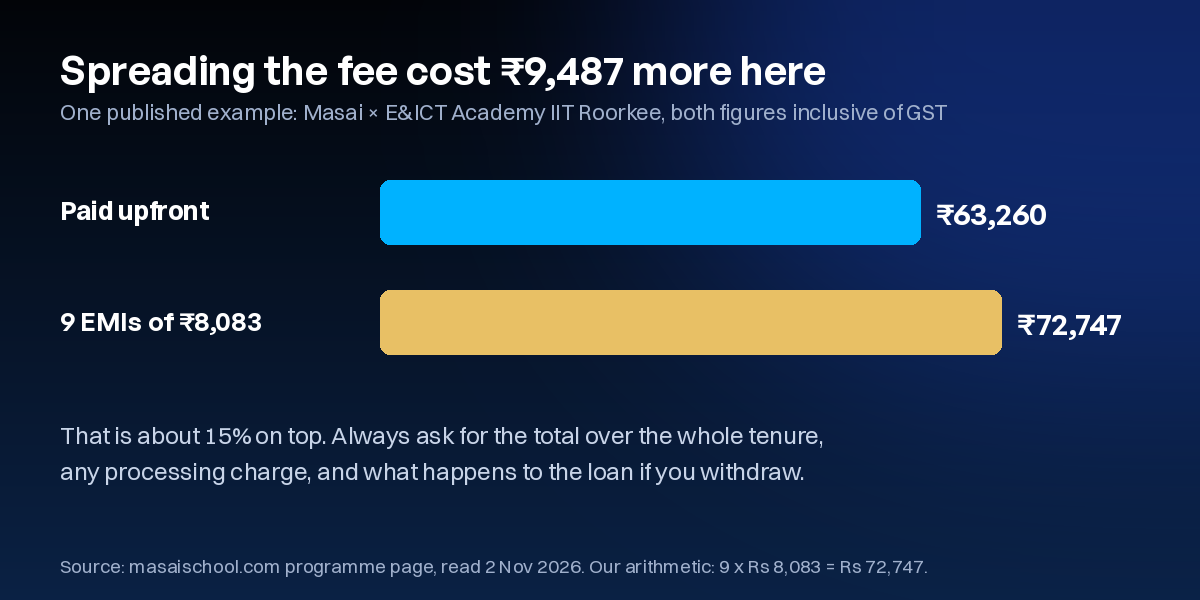
Before you agree to any EMI, ask for four things in writing: the total amount, the number of instalments, any interest or processing charge, and what happens to the loan if you withdraw from the course. Ours starts from ₹4,000 a month, and the counsellor gives you the full schedule in writing before you pay anything. Work out the real total for any course you are considering here:
What will a data analytics course actually cost you?
Enter the figures from any course page. We add 18% GST when a page prints “+ GST” or does not say, so you see the worst case.
For comparison: our Data Analytics programme is ₹90,000 including GST for 118 live hours, about ₹763 per live hour.
Is this good value?
Send us the course name and we will compare it against similar data analytics programmes, using the figures you entered above.
A common mistake: paying ₹30,000 for a course you do not finish is more expensive than paying ₹60,000 for one you do. Price the course you will actually complete.
Is a free data analytics course enough to get hired?
It can be. Employers hiring junior analysts mostly test whether you can pull the right numbers in Excel and SQL, check them, and explain them. None of that requires a paid course.
Microsoft's Power BI learning path on Microsoft Learn is free; you pay only if you sit the PL-300 exam, and that price depends on the country you take it in. Google's certificate gives you 240 hours of structured material for a monthly subscription. If you can study two hours a day for four months without anyone checking on you, free material plus three good projects can get you interviews. What free courses do not give you is someone telling you that your dashboard answers the wrong question, and a cohort that keeps you going in week nine.
Not sure where you stand today? Our free skill check reads your CV against what data analyst job posts ask for and shows the gaps, in about two minutes. No call needed.
Take the 2-minute skill checkWhich route is right for you?
Most people we speak to fit one of four starting points. The right spend is different for each.
- If you are a complete beginner and have never used SQL or Python, a live course with project review is worth paying for. Start with Excel and SQL, not Python.
- If you already use Excel or some SQL at work, you need advanced analytics, Power BI and two or three portfolio projects. A weekend batch fits around your job.
- If you have finished YouTube or Udemy courses but have no projects that hold up in an interview, you need feedback more than new lessons.
- If you are switching careers, your main challenge is becoming employable rather than learning tools. Look for project review, mock interviews and honest placement terms, and compare courses on those.
If you are not sure which one you are, tell us on WhatsApp and we will suggest a learning path.
Is a ₹90,000 data analytics course worth it for you?
Answer five questions. You see the result straight away; nothing is stored.
- 1. Have you tried learning on your own and stalled part-way?
- 2. Do you want a live instructor you can ask questions?
- 3. Do you need someone to review your projects and give feedback?
- 4. Are you trying to switch careers (not just add a skill)?
- 5. Do you need help preparing for interviews?
Before you pay for a data analytics course, ask these 10 questions
- 1How many instructor-led live hours are included?
- 2Who actually teaches the classes, and what do they do at work?
- 3Are projects reviewed individually, and how often?
- 4How large is each batch?
- 5Is placement support conditional, and on what?
- 6What does the refund policy actually say?
- 7Are GST and registration fees included in the figure I was quoted?
- 8Is the EMI truly no-cost, and what is the total?
- 9Can I speak with an existing learner?
- 10Can I attend a class before enrolling?
We have turned these, and eight more, into a one-page comparison sheet you can fill in for every course on your list.
Data Analytics course evaluation checklist (2026)
One page to take into every counselling call, ours included. Tick it off before you pay any institute.
- Actual live hours, and live versus recorded
- Who teaches, and who reviews your projects
- GST, registration and EMI charges in the total
- Refund and placement terms, in writing
- …and 14 more checks
Our Data Analytics programme, and who it is not for
I teach the Data Analytics with Generative AI programme myself. Ishaan Sharma, a Senior Data Scientist at Nuvo AI (Meril Group), teaches alongside me. It is taught live online by working practitioners, with optional classroom labs at our Noida centre, and every session is recorded.
The order follows what employers test: Excel, SQL and Power BI first (34 live hours), then Python, then statistics, modelling and generative AI. You can take it on weekdays at 15 live hours a week over two months, or on weekends at 8 live hours a week over three to four months if you are working. You build 14 portfolio pieces, including two Power BI dashboards, a SQL case study, four Pandas case studies and a capstone you present on demo day. In the generative AI module you build a RAG assistant over a business dataset and an AI agent that runs a recurring report, then write a verification protocol: how you prove the AI's numbers before anyone acts on them.
The fee is ₹90,000 (inclusive of GST) · EMI from ₹4,000/month. Eligible learners are covered by our job guarantee with minimum package assurance, or 50% of the fee back, for those meeting the attendance, deliverable and capstone criteria. Terms and conditions apply. The conditions are written out in full in our job guarantee terms: at least 70% in every assessment, at least 80% live attendance, four or more logged job applications a week, fees settled, and attending the interviews we arrange, within six months of certification. Read them before you pay.
See the full curriculum first. All seven modules with their hours, the 14 portfolio pieces and both batch timings, in a 12-page brochure.
View the curriculumWho this is not for
- People whose budget is closer to ₹5,000 than ₹90,000. A low-cost course plus free material is the sensible choice, and I would tell you that on the call.
- People who cannot give it the hours. Eight live hours a week plus practice is the minimum on the weekend batch.
- People who mainly want a certificate. Employers shortlist on what you can show and explain.
What to do this week
- 1Pick your top three courses and write each one's fee in one column, converted to the final amount including GST, with any registration or application fee added.
- 2Next to each, write the live hours. Where a provider will not tell you, write "not stated".
- 3Ask each provider for the refund policy and the full EMI schedule in writing, and compare those documents rather than the web pages.
- 4If pay is part of your decision, read what a fresher data analyst really earns, so you know both sides of the sum.
Still unsure whether data analytics is right for you?
Send us your current qualification or role and what you are trying to achieve. We pass it to one of our instructors, who are working data scientists, and reply with the skills you would need and whether a structured course makes sense for you at all.
Sources
- Google Career Certificates India: Data Analytics certificate
- PW Skills: Data Analytics With AI, launch post for the 17 Jan 2026 batch
- Masai School: Certification Program in Data Analytics with AI and Gen AI, E&ICT Academy IIT Roorkee
- AnalytixLabs: Data Analyst course in Gurgaon
- Coding Ninjas: Professional Certification in Data Analytics with GenAI, Vishlesan i-Hub IIT Patna
- Microsoft Learn: Power BI Data Analyst Associate (PL-300)
All pages read on 2 November 2026. Figures are as published by each provider; we have not verified what any provider charges in practice. The counselling questions quoted are paraphrased from our own CRM notes, with no names. Nothing here is a promise of a job or a salary.
Frequently asked questions
What is the fee for a data analytics course in India?
On providers' own pages read on 2 Nov 2026, published fees run from Google's self-paced certificate at US$20 a month to ₹1,60,000 for Coding Ninjas' programme with Vishlesan i-Hub, IIT Patna. Most live, multi-month programmes sit between about ₹47,000 and ₹90,000 once GST is included.
Which is the cheapest data analytics course in India?
Free material is cheapest: Microsoft's Power BI learning path on Microsoft Learn costs nothing, and Google's certificate has a 7-day free trial before US$20 a month. Among paid Indian programmes we read, PW Skills' Data Analytics With AI starts at ₹6,999 for its Basic plan, per its launch post for the January 2026 batch.
Is GST included in data analytics course fees?
It depends on the provider. Training attracts 18% GST. AnalytixLabs prints some figures \"including taxes\", Masai prints ₹57,000 + GST and ₹63,260 inclusive, and some pages do not say. Always ask for the final amount including GST and any registration fee.
Is a ₹90,000 data analytics course worth it?
Only if it gives you what you cannot get alone: live teaching hours, a person reviewing your SQL and dashboards, and a schedule you will keep. Divide the fee by the live hours and ask who reviews your work. Our own programme is ₹90,000 including GST for 118 live hours, about ₹763 per live hour.
Can I pay for a data analytics course in EMI?
Most providers offer EMI. Ask for the total you will pay over the whole tenure, not just the monthly figure. On Masai's page, for example, nine EMIs of ₹8,083 add up to ₹72,747, against ₹63,260 paid upfront (both inclusive of GST, read 2 Nov 2026).
Do I need a paid course to become a data analyst?
No. Many analysts learn from free material and get hired on the strength of their projects. A paid course is worth it when you need structure, feedback on your work and help with interviews, and you have checked what it actually includes.
Pankit Kumar has 10 years in Data Science & AI, building and shipping production systems in regulated pharma and clinical environments. He is a freelance trainer at Boston Institute of Analytics, AnalytixLabs and Scaler, and has taught this material to thousands of working professionals.
This article is part of our Data Analytics with Generative AI programme — 3–4 months. The full analyst stack — Excel, SQL, Power BI and Python pipelines — then a generative-AI layer you can prove is right.
Explore Data Analytics with Generative AI