AI Pilots Keep Stalling. That's Why Companies Are Hiring Forward Deployed Engineers
In this article (8 sections)
Related programme: the FDE for Freshers course (6–7 months; EMI from ₹8,000/month · full fee shared on your counselling call). See also open Forward Deployed Engineer jobs in India, updated daily.
In short: companies have spent heavily on AI, but most of it never reaches daily work. MIT's NANDA research found only about 5% of enterprise generative-AI pilots achieved rapid revenue acceleration, and Gartner expects over 40% of agentic AI projects to be cancelled by the end of 2027. The models are not the main problem. Fitting them into a real company's data, systems, rules and habits is. The person hired to do that is the Forward Deployed Engineer (FDE), and demand is rising fast: OpenAI launched a $4 billion company built around FDEs in May 2026, and FDE postings on Indeed India were nearly 19 times higher in June 2026 than a year earlier, from a small base. If you can build software and work with a client, this is the gap worth training for.
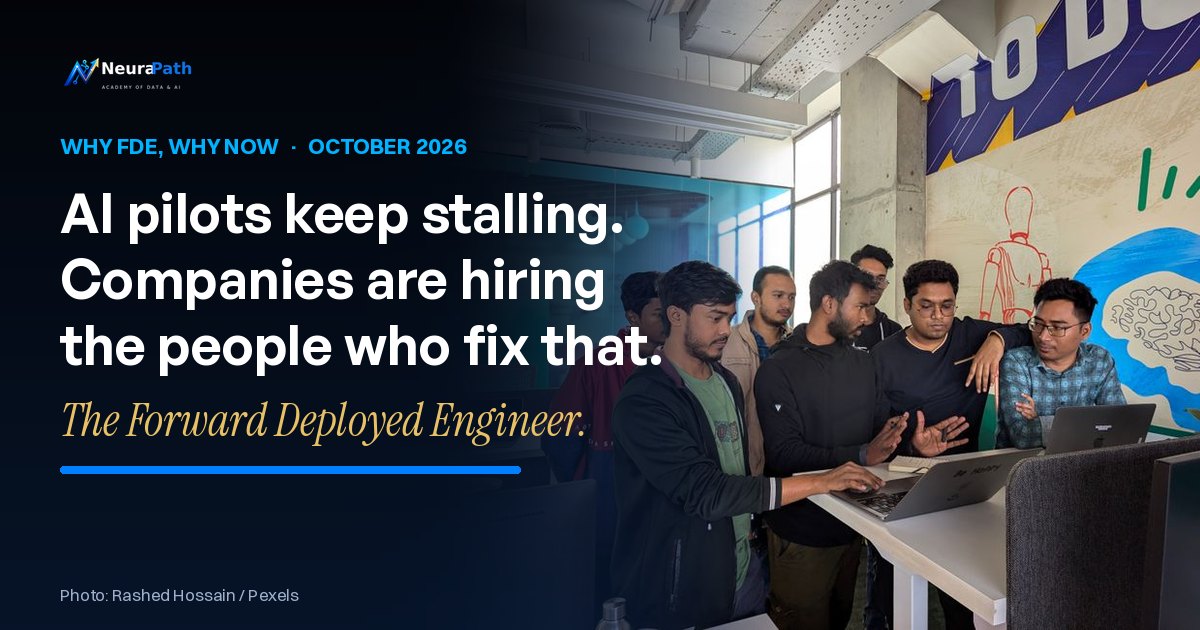
Most AI projects inside companies follow the same story. The demo goes beautifully. A model answers questions about the company's policies, drafts emails, summarises a contract. Leadership is impressed, a pilot is approved, a vendor is signed. Six months later the tool is used by eleven people, nobody trusts its answers, and the budget review asks what happened.
Nothing was wrong with the model. What was missing was the work between the model and the business: understanding how this company actually runs, connecting the AI to its real data and systems, deciding what it must never do, proving it works, and staying until people use it. That work now has a job title, and companies are hiring for it. I teach this role, so I have a stake in it. That is exactly why everything below is a published number with a link, and why there is a section on who this is not for.
Want to train for this role? Our FDE programme follows one long client engagement, from discovery to handover.
Get the FDE programme brochure1. The problem nobody budgeted for: the deployment gap
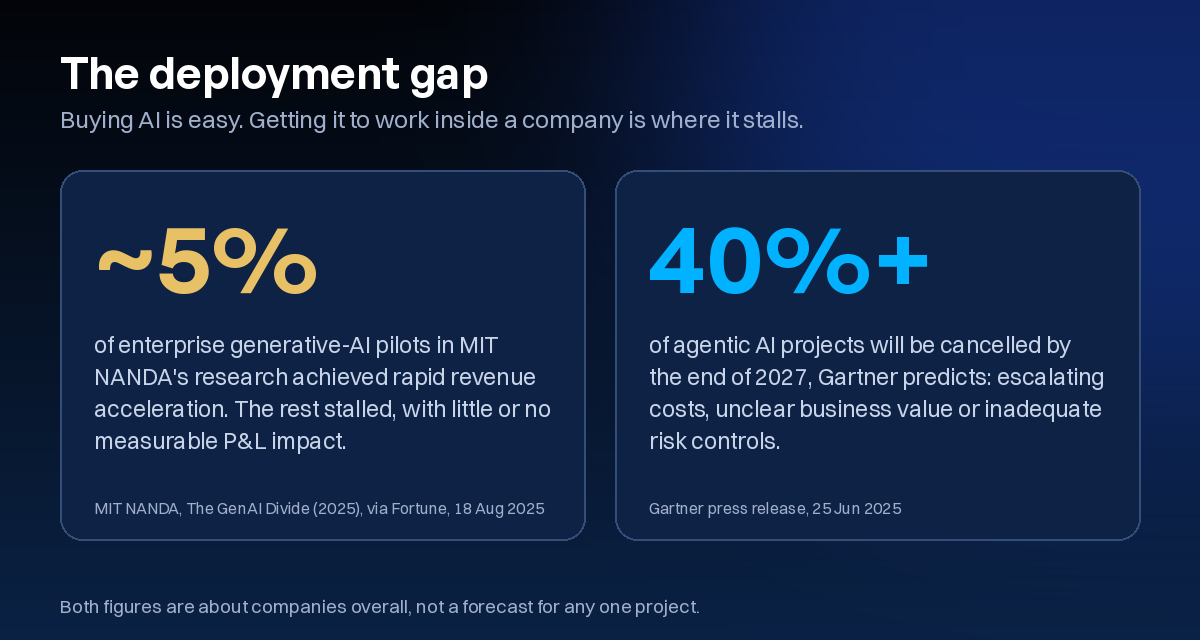
In August 2025, MIT's NANDA initiative published The GenAI Divide: State of AI in Business 2025. Based on 150 interviews with leaders, a survey of 350 employees and an analysis of 300 public AI deployments, it found that about 5% of AI pilot programmes achieve rapid revenue acceleration, while the vast majority stall with little or no measurable impact on profit and loss (Fortune).
The interesting part is the reason. The lead author, Aditya Challapally, told Fortune the core issue is "not the quality of the AI models" but a "learning gap" for tools and organisations. Generic tools work well for individuals and stall inside companies, because they don't learn from or adapt to the company's workflows. The report points to flawed enterprise integration, not regulation or model performance.
Gartner sees the same pattern with AI agents. In June 2025 it predicted that over 40% of agentic AI projects will be cancelled by the end of 2027, because of escalating costs, unclear business value or inadequate risk controls. Its analyst Anushree Verma said most projects are early experiments that can blind organisations "to the real cost and complexity of deploying AI agents at scale, stalling projects from moving into production" (Gartner).
Salesforce put it in one phrase when it explained why it hires FDEs: "Without FDEs, we risk having thousands of customers stuck in pilot purgatory — signed up, but not successfully deployed" (Salesforce). Pilot purgatory is where most corporate AI lives today. Getting it out is a job.
2. The fix turned out to be a person
The Forward Deployed Engineer comes from Palantir, which needed engineers who would sit with a single customer and build what that customer needed. Palantir describes its product engineers as building "one capability, many customers", and its forward deployed engineers as delivering "one customer, many capabilities" (Palantir). For years it was a niche role. Generative AI made it mainstream, because every company buying AI now has the problem Palantir's customers had.
The clearest signal came on 11 May 2026. OpenAI launched the OpenAI Deployment Company with more than $4 billion of initial investment, built to "embed engineers specialized in frontier AI deployment, known as Forward Deployed Engineers, or FDEs, into organizations". It agreed to buy Tomoro, an applied AI consulting firm, to bring about 150 experienced FDEs and deployment specialists on day one (OpenAI). OpenAI's own explanation is the deployment gap in one line: "building powerful AI models is only part of the work."
OpenAI also describes what the work looks like. An engagement starts with "a focused diagnostic of where AI can create the most value", then a few priority workflows chosen with the customer, and then FDEs "work inside the organization to design, build, test, and deploy production systems, connecting OpenAI models to the customer's data, tools, controls, and business processes". Its FDE job description says the person will "own discovery, technical scoping, system design, build, and production rollout" (OpenAI careers).
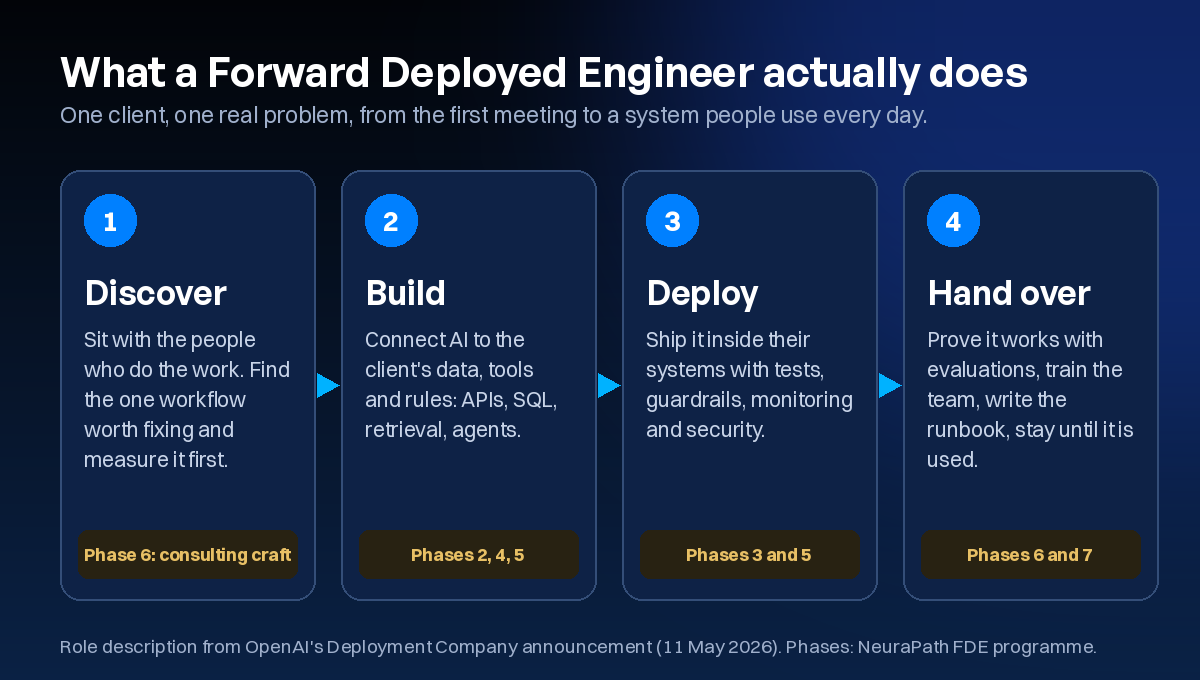
Put simply, an FDE is a software engineer who can also run the client meeting. Half the job is engineering: APIs, data, retrieval, agents, cloud, testing. The other half is the part most engineers are never taught: finding the real problem, agreeing what good looks like, explaining trade-offs to people who are not technical, and staying until the system is used.

3. The demand, in numbers
Here is what the published data says, globally and in India. Each figure measures something slightly different, so read the notes.
| Where | What was measured | Finding | Source |
|---|---|---|---|
| Global (Indeed) | FDE postings index vs January 2025 | April 2026 roughly 729% higher than April 2025 | Business Insider, 17 May 2026 |
| Global (Plank) | Live FDE-titled postings, counted one by one | 1,333 postings at 565 companies on 12 Sep 2026 | Plank |
| India (Indeed) | FDE postings vs the same month a year earlier | Nearly 19x in June 2026 (+1,807%), nearly 16x in July, over 6x in August | PTI, 15 Oct 2026 |
| India GCCs (ANSR) | Postings for forward-deployed and AI-engineering roles | Up roughly 1,000% in twelve months; 65% of new GCC roles need AI skills | ANSR, 24 Sep 2026 |
| India, all white-collar (Naukri) | AI/ML hiring | AI/ML roles up 20% year on year in September 2026; fresher hiring +1% | Naukri JobSpeak, 6 Oct 2026 |
Growth percentages for a new job title start from a small base, and postings are not hires. The Indeed global figures are index values, not counts.
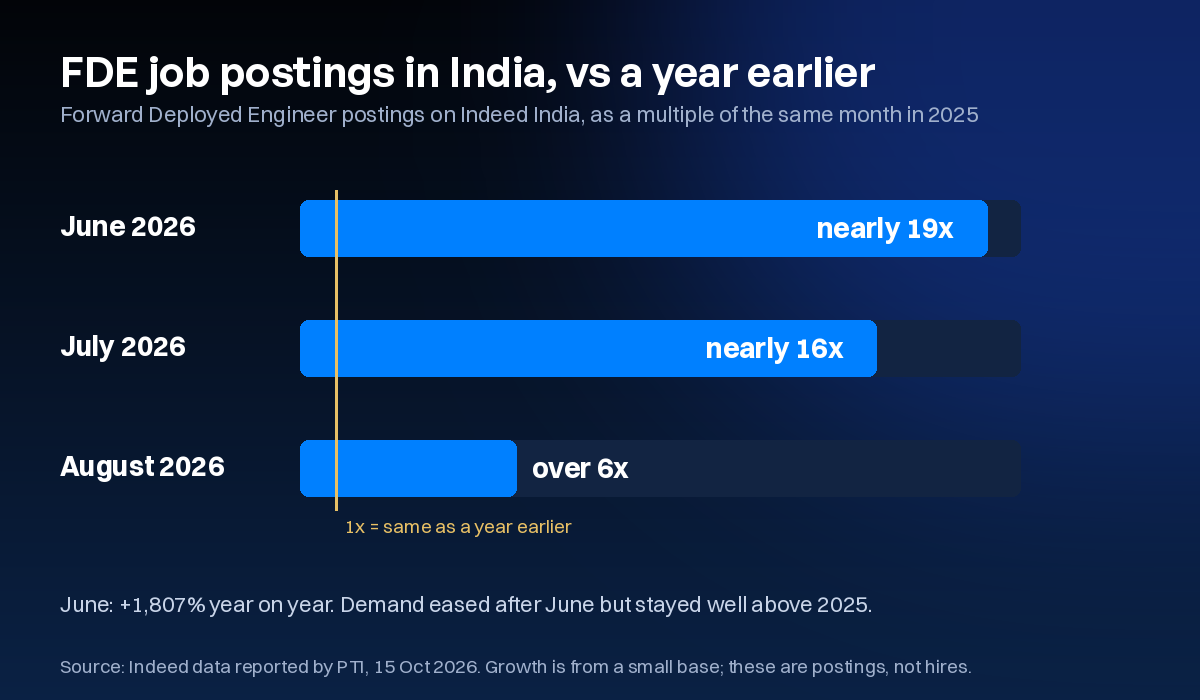
Indeed India's managing director, Sashi Kumar, said the rise "shows that employers are moving quickly". The roles are spread across Bengaluru, Hyderabad, Chennai, New Delhi, Mumbai and remote work (PTI via People Matters). Big US companies are moving too: Business Insider reports that Anthropic, OpenAI, Palantir and Stripe are hiring for the role, that Google Cloud's CEO said it is ramping up FDE hiring, and quotes Box CEO Aaron Levie: forward-deployed engineers "are about to become one of the most in-demand jobs in tech" (Business Insider).
India has its own reason to care. ANSR's report on global capability centres, which employ over 2.1 million people here, names the forward-deployed engineer as one of two talent profiles driving GCC hiring (ANSR). Moneycontrol, citing TeamLease Digital, reports that large IT services firms are expected to eventually have 1.5 to 2% of their workforce in FDE roles (Moneycontrol). For someone already at a services firm, that makes an internal move a real route in.
For the supply side of this story (how many people in India can actually do the job, and who is hiring by name), see our FDE Field Report for October 2026.
4. Why this is the right move now
Plenty of job titles get hyped and fade. Four reasons this one looks different:
- 1It sits on the bottleneck, not the model. Better models do not remove the deployment work; they let companies attempt bigger, riskier workflows, which need more of it. OpenAI says as much: "as models become more capable, businesses can apply AI to larger, more important parts of how they operate."
- 2It rewards skills many Indian engineers already have. Client calls, messy integrations, production support and working inside someone else's systems are daily life in IT services. On our own India jobs board, the most common requirement is client-facing work: 65 of 137 roles on 17 Oct 2026, ahead of AI agents (55) and AWS (39).
- 3The title is still early. Most of the growth in the tables above happened within the last year, so few people yet have a deployed AI project and client delivery experience to show. Early in a role's life, proof of work counts for more than years on the CV.
- 4It is hard to automate away. The job is judgement inside one particular company: which problem matters, what the AI must never do, when to stop. In my view that is the part of software work least exposed to AI coding tools.
On pay, be careful with headlines. TeamLease Digital told Moneycontrol that entry-level FDEs earn between ₹18 lakh and ₹25 lakh a year and mid-level professionals ₹30 to 45 lakh (Moneycontrol). Those are one staffing firm's figures for people who already hold the title. They are a sign of how scarce the skill is, not a promise about what any course, including ours, leads to.
5. Who this is not for
A longer weighing of pay, day-to-day reality and the downsides is in Is Forward Deployed Engineer a good career?. The short version:
- Anyone who wants to avoid code. An FDE ships production software every week. If you dislike programming, look at analyst or product roles instead.
- Anyone who wants to avoid people. You will run meetings, take criticism of your work from non-engineers, and explain delays. If that sounds draining, a pure engineering role will suit you better.
- Anyone expecting an instant senior title. Most postings want experience. On our board the median stated minimum is 4 years, and ANSR puts the median GCC hire at six years. Freshers can get in, mostly through related titles such as Applied AI Engineer, but it takes real projects to show.
- Anyone buying a certificate. There is no official, industry-wide FDE certification. What gets you shortlisted is a deployed project you can demo and explain.
6. How NeuraPath prepares you for this role
We built our FDE programme around the four moves in the diagram above, because that is the job. It runs as one simulated client engagement across seven phases, and each phase ends with something you ship and a mentor reviews, the way a client would:
| Phase | What you learn | What you ship |
|---|---|---|
| 1. Software engineering foundations | Python from zero, Git, testing, problem solving | A tested Python tool on GitHub with a reviewed pull request |
| 2. Data, SQL and APIs | The integration core: databases, REST APIs, joining messy data | A service that combines a database and a live API behind your own API |
| 3. Production engineering and cloud | Docker, CI/CD, cloud deployment, monitoring | That service, containerised and live on the cloud |
| 4. Applied ML and GenAI | LLM APIs, prompt and context engineering, production RAG | A RAG assistant over real documents, with an evaluation suite |
| 5. Agentic AI, MCP and LLMOps | Agents, tools, MCP, guardrails, evals, observability | A deployed agent system with guardrails and monitoring |
| 6. The consulting craft | Discovery, scoping, stakeholders, demos | A recorded mock discovery and demo, with a mentor playing a difficult client |
| 7. Capstone engagement | A full engagement end to end, plus interview preparation | A complete project presented to an industry panel |
About 280 learning hours over 6 to 7 months, including live sessions, self-study and projects. Live classes are 3 hours on Saturday and Sunday mornings, so most people keep their job.

- Taught live by practitioners. I lead the programme (Senior Data Scientist at Parexel, about 10 years in data science and AI), with Ishaan Sharma (Senior Data Scientist at Nuvo AI) on generative AI. Sessions are recorded, and there are optional hands-on labs at our Noida centre.
- Small batches. 15 to 20 learners, so every project gets a real code review.
- Phase 6 exists on purpose. Most courses teach the engineering half. The client half is what employers list first, so we grade it.
- A job guarantee with published terms. Eligible learners are covered by our job guarantee with minimum package assurance, or 50% of the fee back, for those meeting the attendance, deliverable and capstone criteria. Terms and conditions apply. Read the full terms.
- Honest about where we are. Our first FDE batch started on 16 August 2026 and is still in training, so we have no FDE placement record yet. Be wary of anyone showing you one for a course category this new.
7. What to do this week
- 1Read three real job posts. Open our live India FDE jobs board and note what each one asks for that you can't show yet. That list is your study plan.
- 2Check where you stand. Run your CV through our free FDE skill check. It takes about five minutes and shows which requirements you already meet.
- 3Build one small deployed thing. Not a notebook: something with a URL that a non-engineer can use. It will teach you more about this job than any article, including this one.
Sources
- Fortune: MIT report finds 95% of generative AI pilots at companies are failing (MIT NANDA, The GenAI Divide: State of AI in Business 2025), 18 Aug 2025
- Gartner: Over 40% of agentic AI projects will be canceled by end of 2027, 25 Jun 2025
- Salesforce: Today's hottest role, Forward Deployed Engineer, 19 Nov 2025
- OpenAI: OpenAI launches the OpenAI Deployment Company, 11 May 2026
- OpenAI careers: Forward Deployed Engineer job description
- Palantir blog: Dev versus Delta, demystifying engineering roles at Palantir
- Business Insider: Job postings for this tech role have grown more than 700% in the last year, 17 May 2026 (corrected: Indeed index values)
- Plank: The FDE job market (1,333 live postings at 565 companies, 12 Sep 2026)
- People Matters / PTI: Demand for forward deployed engineers jumps 19-fold in India (Indeed data), 15 Oct 2026
- ANSR via GlobeNewswire: Talent Trends in GCCs in India, 24 Sep 2026
- Naukri JobSpeak, September 2026 (published 6 Oct 2026)
- Moneycontrol: Entry-level FDEs earn up to 7 times more than software developers (TeamLease Digital), 21 Jul 2026
- NeuraPath FDE jobs board (India roles we track, a fraction of all postings), 17 Oct 2026
- Photo: Rashed Hossain, Pexels
- Photo: ThisIsEngineering, Pexels
- Photo: Varun Bhatheja, Pexels
All sources read on 17 October 2026. Figures are as each source published them; growth figures for a new job title start from a small base, and postings are not hires. Photos are from Pexels under the Pexels licence. Nothing here is a promise of a job or a salary.
Frequently asked questions
Why are companies hiring forward deployed engineers?
Because most company AI projects stall between the demo and daily use. MIT's NANDA research found only about 5% of enterprise generative-AI pilots achieved rapid revenue acceleration, and Gartner expects over 40% of agentic AI projects to be cancelled by the end of 2027. FDEs are the engineers who connect AI to a company's real data, systems and rules, and stay until it is used.
Is forward deployed engineer a good career in India in 2026?
Demand is rising from a small base. Indeed data reported by PTI shows FDE postings in India were nearly 19 times higher in June 2026 than a year earlier, and ANSR found postings for forward-deployed and AI-engineering roles in India's GCCs rose about 1,000% in twelve months. Most roles still want a few years of experience, so freshers usually start through related titles and real projects.
What did OpenAI's Deployment Company announce?
On 11 May 2026 OpenAI launched the OpenAI Deployment Company with more than $4 billion of initial investment, to embed Forward Deployed Engineers inside organisations. It agreed to acquire Tomoro, bringing about 150 experienced FDEs and deployment specialists from day one.
Do I need experience to become a forward deployed engineer?
Most postings ask for some: the median stated minimum on our India jobs board is 4 years, and ANSR puts the median GCC hire at six years. Entry-level roles exist, and related titles such as Applied AI Engineer are more open to early-career candidates. A deployed project you can demo matters more than certificates.
How does NeuraPath's FDE programme work?
It runs as one simulated client engagement over seven phases and about 280 learning hours, with live weekend classes taught by practitioners. Each phase ends with a project you ship and a mentor reviews, including a graded discovery and demo roleplay. Eligible learners are covered by a job guarantee whose full terms are published at neurapath.in/terms#job-guarantee.
Pankit Kumar has 10 years in Data Science & AI, building and shipping production systems in regulated pharma and clinical environments. He is a freelance trainer at Boston Institute of Analytics, AnalytixLabs and Scaler, and has taught this material to thousands of working professionals.
This article is part of our FDE for Freshers programme — 6–7 months. Build your engineering foundations, then take AI from discovery to delivery.
Explore FDE for Freshers