In this article (17 sections)
- What does an AI engineer actually do?
- What do employers ask for?
- Can a fresher or a non-CS graduate do this?
- What is the 32-week AI engineer roadmap?
- Stage 1, weeks 1 to 5: Python and engineering foundations
- Stage 2, weeks 6 to 9: data, SQL and APIs
- Stage 3, weeks 10 to 13: maths and classical machine learning
- Stage 4, weeks 14 to 17: deep learning and NLP
- Stage 5, weeks 18 to 21: LLMs, prompting and RAG
- Stage 6, weeks 22 to 25: agents, MCP and fine-tuning
- Stage 7, weeks 26 to 29: evaluation, deployment and security
- Stage 8, weeks 30 to 32: capstone and interviews
- Should you self-study or take a course?
- Who teaches our AI Engineer programme, and what do you build?
- Who this is not for
- What to do this week
- Sources
Related programme: the AI Engineer course (32 weeks; ₹95,000 (inclusive of GST) · EMI from ₹4,000/month).
In short: yes, you can become an AI engineer starting from no coding. It takes eight stages, in this order: Python, then data, SQL and APIs, then maths and classical machine learning, deep learning, LLMs and RAG, agents and fine-tuning, production skills, and a deployed capstone. At 12 to 14 hours a week that is about 32 weeks. In 30 AI engineer postings in India that I read on 16 and 17 November 2026, 28 named LLMs or generative AI, 26 named evaluation or testing, and 24 named Python. Seven were open to freshers or entry level.
I am Pankit Kumar. I lead the AI Engineer programme at NeuraPath and work as a Senior Data Scientist at Parexel. The question I am asked most this year is "how do I become an AI engineer, and can I do it from where I am?" To answer it with evidence, I opened 30 current job postings in India, wrote down every skill each one names, and laid the counts next to our 32-week syllabus. This article is the route that came out of that, with one free resource for every stage.
Not sure where you would start? Book a 15-minute counselling call and we will tell you which stages you can move through quickly.
What does an AI engineer actually do?
An AI engineer builds software that has a model inside it. Today that model is usually a large language model, and the work around it is most of the job: getting the right data to the model, connecting it to tools and other systems, testing whether its answers are right, and keeping it running at a sensible cost. TerraTern's posting puts it plainly: "Test every feature on real questions, and fix wrong or unclear answers before users see them."
Three neighbouring roles get confused with it:
- A data scientist asks what the data says and builds models to predict from it. More statistics and analysis, less software. Our Data Science programme follows that path.
- A machine learning engineer trains models and serves them at scale. The same family as AI engineering, with more weight on training pipelines and less on LLM applications. Eight of the 30 postings I read carry "AI/ML" in the title and describe a mix of the two.
- A forward deployed engineer does AI engineering inside a client's business: discovery with the people who do the work, then building, deploying and handing over. If the client-facing side appeals to you, see our Forward Deployed Engineer programme.
What do employers ask for?
I read 30 postings titled AI Engineer, Associate AI Engineer, AI/ML Engineer or Generative AI Engineer on their LinkedIn India pages, late on 16 November 2026 and just after midnight on the 17th. Eleven were in Bengaluru. For each one I marked which of 14 skills it names anywhere in the text.
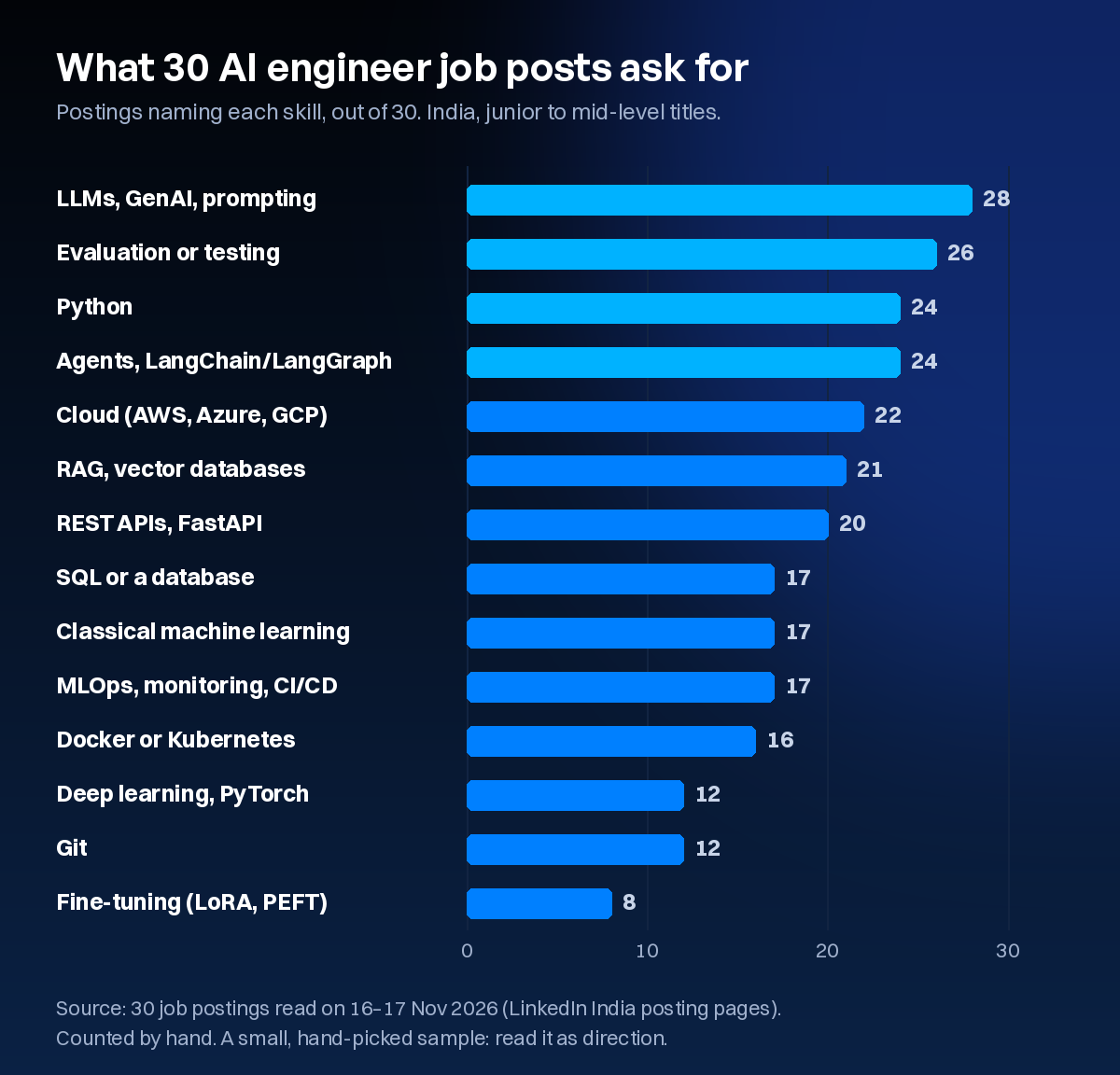
| Skill | All 30 postings | The 7 open to freshers or entry level |
|---|---|---|
| LLMs, generative AI or prompt engineering | 28 | 6 |
| Evaluation or testing | 26 | 7 |
| Python | 24 | 7 |
| Agents or an agent framework (LangChain, LangGraph) | 24 | 6 |
| Cloud (AWS, Azure, GCP) | 22 | 5 |
| RAG, embeddings or a vector database | 21 | 5 |
| REST APIs or FastAPI | 20 | 7 |
| SQL or a relational database | 17 | 5 |
| Classical machine learning | 17 | 3 |
| MLOps: monitoring, observability, CI/CD | 17 | 4 |
| Docker or Kubernetes | 16 | 4 |
| Deep learning (PyTorch, TensorFlow, transformers) | 12 | 2 |
| Git or version control | 12 | 6 |
| Fine-tuning (LoRA, PEFT) | 8 | 2 |
Source: 30 postings on LinkedIn India, read by hand on 16 and 17 Nov 2026. I chose them from search results and leaned towards associate and junior titles, so read the counts as direction, not market share.
Two things stand out. Evaluation or testing is the second most named skill, ahead of Python, and all seven fresher-friendly postings name it. Wipro asks for "evaluation frameworks, golden datasets, model accuracy, and performance metrics"; Grundfos asks for "validation of AI-generated outputs". Employers have seen enough demos. They want people who can show an answer is right.
The second is how much plain software engineering sits in the list: APIs in 20 postings, cloud in 22, Docker in 16. Fine-tuning, the topic most people want to start with, is named in 8.
Can a fresher or a non-CS graduate do this?
Yes, and the postings show where. Seven of the 30 were open to freshers or described as entry level in their own text, and at least four more set the minimum at one year (Grundfos, KPMG India, EcoRatings and Jaggaer).
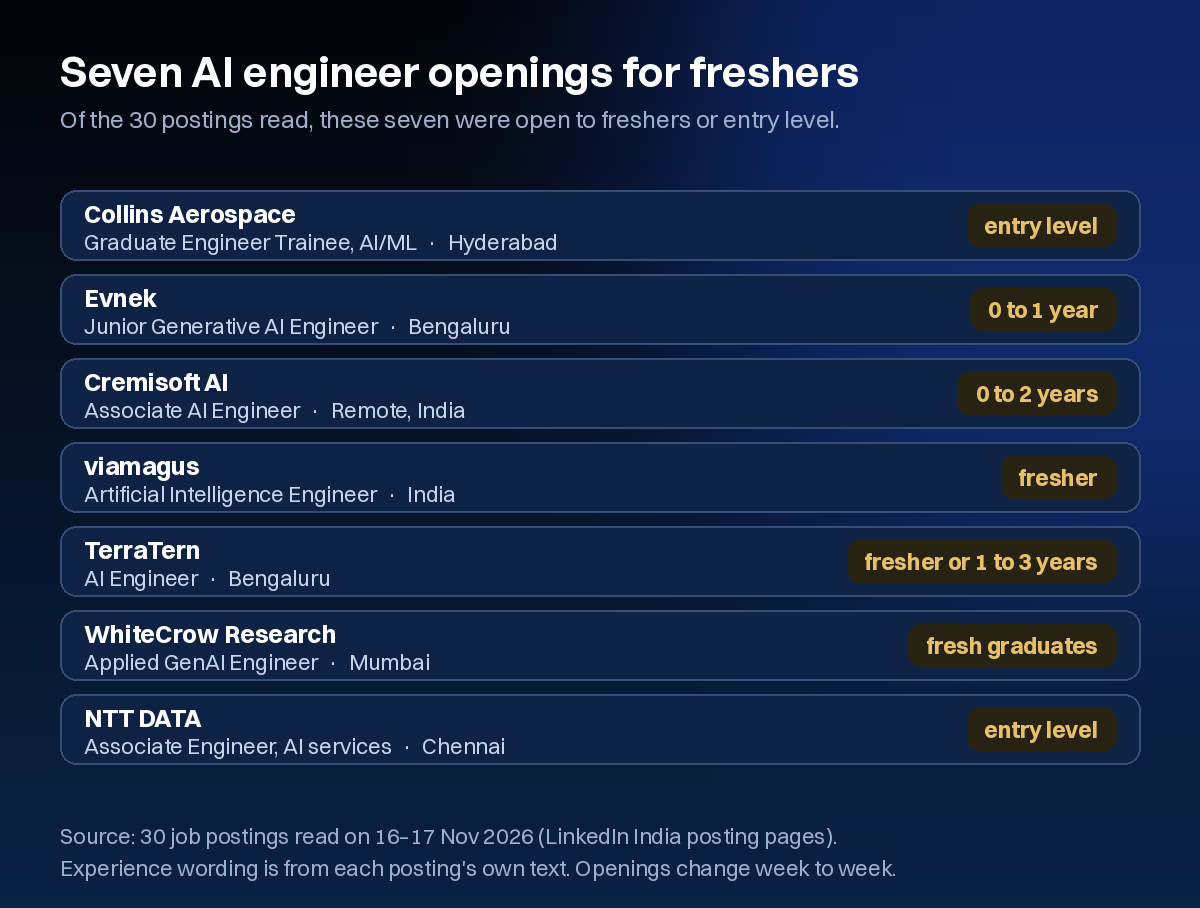
The entry titles to search for are Graduate Engineer Trainee (AI/ML), Associate AI Engineer, Junior Generative AI Engineer and Associate Engineer (AI services). The seven employers were of three kinds: startups and small product companies (TerraTern, Cremisoft AI, viamagus, Evnek, WhiteCrow Research), an IT services firm (NTT DATA) and the India engineering team of a multinational (Collins Aerospace). Read the experience line as well as the title, because the title alone does not tell you the level: Optum India's Associate AI/ML Engineer asks for 3+ years. A sample taken from one job board on one night also misses campus drives and trainee programmes, so the real number of doors is larger than seven in 30.
What these employers ask of a fresher is specific. Cremisoft AI says "internships and academic projects count". viamagus says "we look at what you've built more than your marks". Collins Aerospace values "strong programming fundamentals, analytical thinking, curiosity, and the ability to learn quickly over extensive experience with specific AI frameworks". In all seven, Python, APIs and testing are named. So the way to compete is a small number of finished projects on GitHub, each with a test set and a short note on where it fails.
On degrees: most postings that named one asked for computer science, engineering or "a related field". Some set no branch, and WhiteCrow Research wrote that "equivalent practical experience and strong project work are also welcome". If your degree is in commerce, science or arts, apply to the roles that judge projects, and make the projects easy to find. Pay is a separate question with its own sources, so I have left it out of this article.
Want the full week-by-week syllabus? Our AI Engineer page lists all 8 phases and 26 modules, with the tools and the project in each.
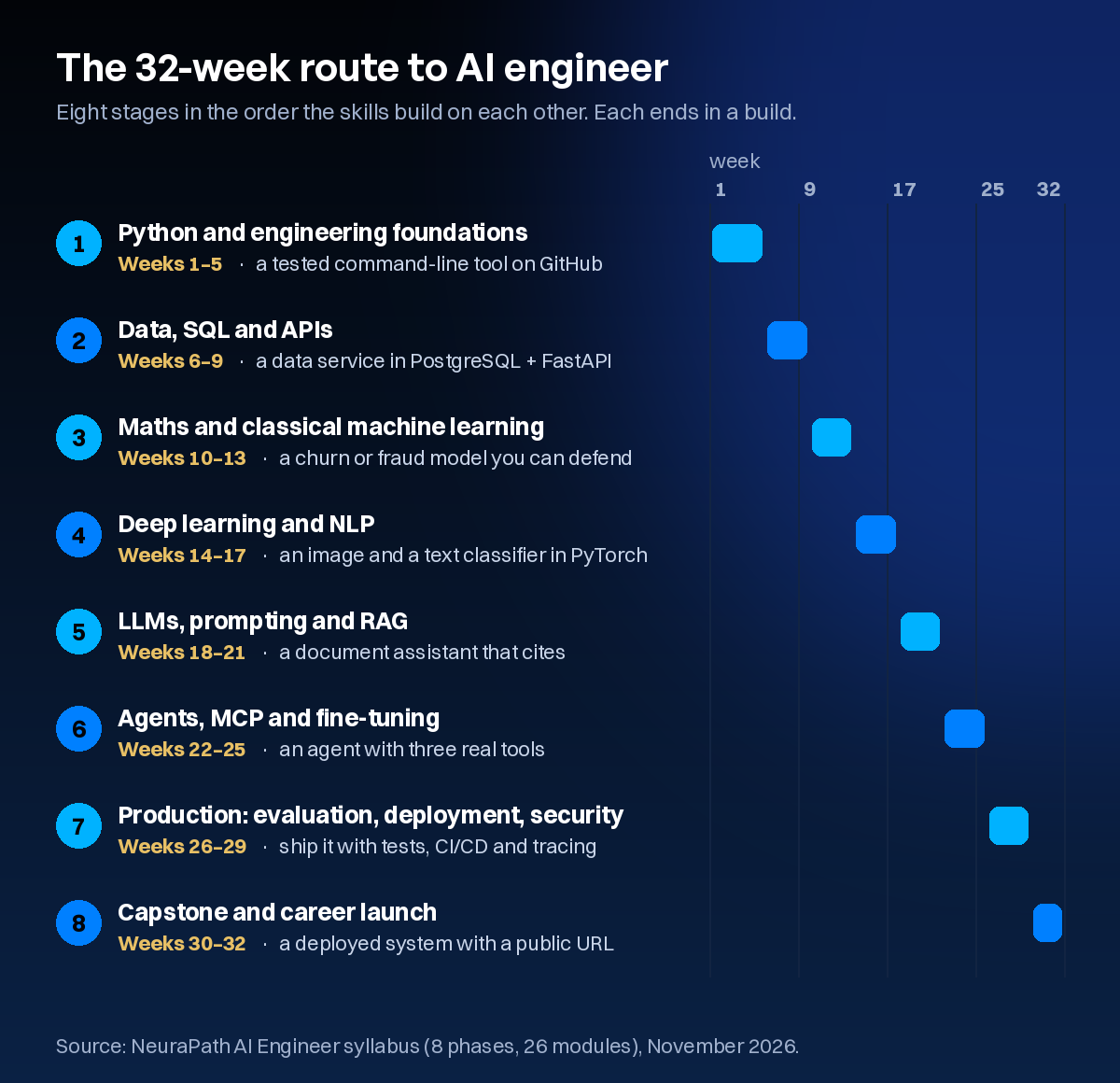
See the 32-week syllabusWhat is the 32-week AI engineer roadmap?
Eight stages, each ending in something you build. The order matters more than the speed. The week ranges are the ones in our own syllabus and assume 12 to 14 hours a week; on your own, with less time, stretch the weeks and keep the order. I opened each free resource below on 17 November 2026.
Stage 1, weeks 1 to 5: Python and engineering foundations
Learn Python from the first line: data types, functions, classes, files and errors. Alongside it, Git and GitHub, the command line, and how to check what an AI coding assistant writes for you. Build a small command-line tool with tests and a README another person can follow. Free resource: Harvard's CS50P, "an introduction to programming using a language called Python", with ten weeks of material you can take free through its OpenCourseWare.
Stage 2, weeks 6 to 9: data, SQL and APIs
SQL up to joins, CTEs and window functions; pandas for cleaning messy files; then calling other people's APIs and building your own with FastAPI. This is where most of the daily work in the job sits, and 20 of the 30 postings named APIs. Build a data service: messy files cleaned into PostgreSQL and served through a documented endpoint. Free resources: the tutorial in the PostgreSQL documentation, then the official FastAPI tutorial, which works through the framework "step by step".
Stage 3, weeks 10 to 13: maths and classical machine learning
Vectors, probability and gradient descent, explained with code. Then regression, trees, gradient boosting, and how to evaluate a model without fooling yourself. This is the first stage people skip, and they regret it in interviews: 17 of the 30 postings named classical machine learning, and it is how an interviewer finds out whether you know what a model is doing. Build a churn or fraud model with a written evaluation. Free resource: Google's Machine Learning Crash Course, whose 12 modules run from linear regression to an introduction to large language models.
Stage 4, weeks 14 to 17: deep learning and NLP
Neural networks in PyTorch, from a training loop you write yourself to transfer learning, embeddings and the transformer. After this, an LLM is an extension of something you understand. Build an image classifier and a text classifier. Free resource: fast.ai's Practical Deep Learning for Coders, nine lessons of about 90 minutes each, which uses PyTorch and Hugging Face Transformers and expects you to code already.
Stage 5, weeks 18 to 21: LLMs, prompting and RAG
How an LLM generates text, how to call hosted and open models, and how to make one answer from your documents with retrieval (RAG): chunking, embeddings, a vector database, citations, and refusing when the answer is not there. Build a document assistant that cites its sources, with a set of test questions and a measured accuracy figure. Free resource: the Hugging Face LLM Course, which says it is "completely free and without ads" and suggests 6 to 8 hours a week per chapter.
Stage 6, weeks 22 to 25: agents, MCP and fine-tuning
Tool calling, agent patterns with LangChain and LangGraph, and human approval for risky actions. Then the Model Context Protocol, which its documentation calls "an open-source standard for connecting AI applications to external systems", and LoRA fine-tuning for the cases where RAG is not enough. Build an agent with three real tools. Free resources: the Hugging Face AI Agents Course, which covers smolagents, LlamaIndex and LangGraph at 3 to 4 hours a week, and the MCP introduction.
Stage 7, weeks 26 to 29: evaluation, deployment and security
This is the second stage people skip, and the one the postings ask for most. Tests for AI applications, a golden dataset you re-run after every change, Docker, a cloud deployment, a CI/CD pipeline, tracing, and the basics of prompt injection. Build nothing new: take the stage 5 or 6 project and ship it properly. Free resource: the Docker workshop in Docker's documentation, a 15-minute tutorial in which you run a container and package an application as an image.
Stage 8, weeks 30 to 32: capstone and interviews
One complete system for a real or realistic brief: scoped, built, evaluated, deployed, and demonstrated to people who ask hard questions. Finish with a public URL, an evaluation report and a runbook, then practise explaining it. Free resource: Hugging Face Spaces for hosting a demo. Read the plan notes first: on 17 November 2026 its documentation said static Spaces are free for everyone and free personal accounts can host up to two Gradio Spaces on ZeroGPU.
Should you self-study or take a course?
You can learn every stage above without paying. The resources I listed are enough to get the knowledge.
What self-study does not give you is harder to see from the outside. Nobody reads your code or tells you that your evaluation leaks test data. Nobody sets a deadline in the week your job gets busy. Nobody asks "why did you choose that?" until an interviewer does. Taught programmes exist to supply those. The ones sold in India vary a lot in length: on their own pages on 16 November 2026, Simplilearn's Microsoft AI Engineer Program ran 24 weeks and Scaler's AI & Machine Learning Program 12 to 15 months. Nearly all of the eight I read teach Python, machine learning, deep learning, LLM APIs, RAG, agents and fine-tuning. Fewer list LLM evaluation or Docker in full, and evaluation was the second most named skill in the postings. Check for both before you pay anyone.
If you have a mentor at work or a serious study group, start free. If you have tried twice and stalled around stage 3, structure is probably what is missing.
Who teaches our AI Engineer programme, and what do you build?
I teach Python, data and machine learning. Ishaan Sharma, a Senior Data Scientist at Nuvo AI, teaches generative AI and agents. The programme follows the eight stages above over 32 weeks, starts from zero coding, and takes up to 20 learners in a batch. It is taught live online by working practitioners, with optional classroom labs at our Noida centre, so you can join from Bengaluru, Hyderabad, Chennai or Pune as easily as from Delhi NCR. Live classes are at weekends, about 6 hours a week, with 6 to 8 hours of practice.
There is one project per stage. The stage 6 project is a support or operations agent with three real tools, an MCP server, human approval for risky actions, and a LoRA-tuned model for one step. In stage 7 you deploy it with tests, a CI/CD pipeline, tracing, an evaluation report and a runbook.
The fee is ₹95,000 (inclusive of GST) · EMI from ₹4,000/month. The last phase covers your portfolio, AI system design interviews and mock interviews. The full syllabus is on the AI Engineer course page.
Who this is not for
- People who cannot give 12 to 14 hours a week for eight months. The stages build on each other, and missed weeks are hard to recover.
- People who want to use AI tools without writing code. This is an engineering programme from week 1.
- People who want to skip the maths and the testing. Those are the parts interviews check.
- People who mainly want analysis and modelling work. The Data Science route fits better.
What to do this week
- 1Open five AI engineer postings in the city you want, with "associate", "junior", "trainee" or "0 to 2 years" in them, and list every skill they name. Compare your list with the table above.
- 2Start stage 1 today: create a GitHub account, do the first week of CS50P, and commit your first file. If you already code, build the smallest RAG you can: ten documents, five questions, and a note on which answers were wrong.
- 3Run your CV through our free skill check to see which requirements you already meet, then block 12 hours in next week's calendar.
Sources
Job postings were read on LinkedIn India on 16 and 17 November 2026; free resources on 17 November 2026; course pages on 16 November 2026.
- Collins Aerospace: Graduate Engineer Trainee, AI/ML, Hyderabad (LinkedIn)
- Cremisoft AI: Associate AI Engineer (GenAI / Agentic AI), India (LinkedIn)
- Evnek: Generative AI Engineer, Bengaluru (LinkedIn)
- viamagus: Artificial Intelligence Engineer, India (LinkedIn)
- TerraTern: AI Engineer, Bengaluru (LinkedIn)
- WhiteCrow Research: Applied GenAI Engineer, Mumbai (LinkedIn)
- NTT DATA: Associate Engineer, AI services, Chennai (LinkedIn)
- Wipro: AI ML Engineers, Pune (LinkedIn)
- Grundfos: CBS CSU Associate AI Engineer, Chennai (LinkedIn)
- The other 21 postings, with links, experience lines and the full skill grid, are in the research notes kept with this article.
- Harvard CS50's Introduction to Programming with Python
- PostgreSQL documentation: Tutorial
- FastAPI: Tutorial - User Guide
- Google for Developers: Machine Learning Crash Course
- fast.ai: Practical Deep Learning for Coders
- Hugging Face: LLM Course
- Hugging Face: AI Agents Course
- Model Context Protocol: What is MCP?
- Docker Docs: Docker workshop
- Hugging Face Hub documentation: Spaces overview
- Simplilearn: Microsoft AI Engineer Program
- Scaler: AI & Machine Learning Program with Agentic AI
Frequently asked questions
How long does it take to become an AI engineer?
From no coding at all, plan on about 32 weeks at 12 to 14 hours a week to cover the eight stages in this roadmap. If you already write Python and SQL at work, the first two stages shrink and five to six months is realistic. The hours matter more than the calendar.
Do I need a degree in computer science to become an AI engineer?
Not always. Most of the 30 postings I read on 16 and 17 Nov 2026 asked for a bachelor's degree in computer science, engineering or a related field, but some set no branch at all, and WhiteCrow Research wrote that equivalent practical experience and strong project work are also welcome. A public project you can explain does a lot of the work a degree title would.
Is maths required for AI engineering?
Yes, a working amount: vectors and matrices, probability, gradient descent and the statistics behind a fair test. You do not need a maths degree. Classical machine learning was named in 17 of the 30 postings I read, and interviewers use it to check whether you understand what a model is doing.
What is the difference between an AI engineer and a data scientist?
A data scientist spends most of the week on analysis and models: finding out what the data says and predicting from it. An AI engineer spends most of it on building software around models, mainly large language models: APIs, retrieval, agents, tests and deployment. The two share Python, SQL and machine learning basics.
Can I become an AI engineer while working full time?
Yes, if you can protect 12 to 14 hours a week for about eight months. A common pattern is two long weekend sessions and three short weekday ones. It does not work on leftover time, so put the hours in your calendar before you start.
Is an AI engineer course worth it?
It depends on what you lack. Every topic in this roadmap has good free material, so you are not paying for information. A taught course is worth it if you need live teaching, someone to review your code and your evaluation, deadlines, and practice for interviews. If you already have those through work or a study group, self-study is a fair choice.

Pankit Kumar has 10 years in Data Science & AI, building and shipping production systems in regulated pharma and clinical environments. He is a freelance trainer at Boston Institute of Analytics, AnalytixLabs and Scaler, and has taught this material to thousands of working professionals.
This article is part of our AI Engineer programme — 32 weeks. Python, machine learning, deep learning, LLM applications and the engineering that gets them into production.
Explore AI Engineer